![[2026 Guide] Is Writing by Hand Inefficient? The Neuroscience of Handwriting Memorization & Smart Study Protocols](https://pathmemoria.tsmichi.com/blog/handwriting_memorization_hero.jpg)
Hello everyone, I'm Teacher Taku.
"Isn't writing vocabulary words or kanji dozens of times in a notebook just exhausting busywork and a waste of time...?"
"I saw on social media and in study books that writing is inefficient and I should just repeatedly read, but when actual exams arrive, I freeze up and cannot spell words or write characters accurately..."
"Ultimately, is writing or reading scientifically superior? I am completely confused by contradictory advice..."
Over my 20+ years coaching high school students in the classroom, dozens of students and parents ask me these exact questions every year.
On one side, traditionalists demand old-school brute-force drilling ('hammer it into your muscle memory by writing non-stop'). On the other side, digital efficiency advocates insist on extreme passive skimming ('writing is obsolete, just read faster'). As a result, dedicated learners get trapped between these extremes.
However, cognitive psychology, cutting-edge electroencephalography (EEG) brainwave research, and frontline classroom practice point to an unmistakable truth:
Transcribing words while looking at a textbook yields near-zero memory retention. In contrast, active retrieval testing—pulling answers out of memory onto paper without looking—dramatically stimulates the parietal cortex and sensorimotor networks, producing far deeper memory consolidation than reading alone.
The problem is not handwriting itself; the problem lies in the flawed protocol of how you write.
In this comprehensive 2026 guide, we unpack the neurobiological mechanisms behind why mindless transcription fails, explore the cutting-edge brainwave science proving the power of active handwriting recall, and introduce practical iPad, tablet, and smartphone protocols—featuring PathMemoria's brand-new Handwriting Mode!
- •Why Mindless Copying Fails: How transcribing with a textbook open triggers the illusion of fluency without hippocampal retention
- •NTNU Brainwave Evidence: How 2024 EEG research proves stylus handwriting synchronizes theta and alpha neural networks
- •The Blank Canvas Output Protocol: Eliminating spelling mistakes and character recall gaps under exam pressure
- •Hybrid Desk & Mobile Workflow: Seamlessly switching between desk handwriting and commute multiple-choice in one tap
- 1. Transcribing While Looking at Textbooks: Merely shuttling eyes back and forth; the hippocampus experiences zero cognitive retrieval strain.
- 2. Writing the Same Word 10 Times Consecutively: After the 2nd repetition, the brain shifts into autopilot, producing arm fatigue with zero memory trace.
- 3. Abandoning Notes After Color-Coding: Feeling satisfied with aesthetic visual notes, completely neglecting spaced review intervals when retention decays.
Why Handwriting is Often Criticized as Inefficient: The Cognitive Science
Modern study influencers often proclaim that "writing by hand is outdated" or "handwriting wastes precious study time." While their criticisms contain valid points, misunderstanding the science can severely damage your actual exam scores. First, let us examine the neurobiological reasons why traditional rote handwriting fails.
Transcribing While Looking at Textbooks Has Near-Zero Retention
Many students spend hours crafting beautiful summary notebooks or copying vocabulary lists before exams. Sitting with a textbook open and meticulously copying passages onto lined paper looks remarkably diligent on the surface.
However, according to the seminal Levels of Processing framework proposed in cognitive psychology (Craik & Lockhart, 1972), this behavior represents only "shallow processing." You are simply routing visual patterns from your retina through arm muscles onto paper. The hippocampus—the brain's master memory gateway—remains largely disengaged.
In high school classrooms, I routinely observe students who fill multiple immaculate notebooks. Yet when I ask them to close the book and recite the definition they just wrote, they frequently cannot recall it. When information is physically visible, the brain conserves metabolic energy by refusing to forge durable synaptic connections. Copying while looking is clerical busywork, not genuine learning. For foundational principles, explore our Science-Backed Memorization Complete Guide.
Wasting Motor Energy: Muscular Fatigue Without Hippocampal Retrieval Load
Most learners have experienced writing a single foreign word ten times across a notebook line. When the page is filled with dark graphite, fingers develop calluses, and the wrist aches, one feels an overwhelming sense of academic accomplishment.
In cognitive neuroscience, this is the classic "Illusion of Fluency." Your motor cortex and hand muscles consumed significant calories, but long-term conceptual encoding was entirely bypassed.
When you write the same word repeatedly, conscious thought occurs only during the first one or two repetitions. From the third repetition onward, your brain switches to motor autopilot, mechanically tracing the line written directly above. Because no cognitive retrieval effort ("What was that letter again...?") is exerted, the memory evaporates by the next morning. Muscle fatigue does not equal retention.
Comparing with Reading-Only Study: Why Seeing Fails on Written Exams
Learners often wonder: "If handwriting is time-consuming, shouldn't I just skim vocabulary decks repeatedly at high speed?" Reading quickly through flashcards is indeed effective for establishing initial familiarity and broad contextual overviews.
However, a dangerous trap emerges on test day.
Cognitive psychology distinguishes sharply between two retrieval mechanisms: "Recognition" (identifying familiar items when options are visible) and "Recall" (generating target knowledge onto a blank canvas from memory). Studying exclusively by viewing flashcard screens strengthens recognition circuits while leaving recall circuits completely unexercised.
Consequently, students arrive at the exam hall and freeze: "Was that word spelled with 'r' or 'l'?" or "Which radical belongs in this complex kanji?" While multiple-choice exams tolerate recognition alone, written exams, essays, and technical certifications demand unassisted recall. Practicing on blank paper is indispensable.
NTNU Neuroscience Research: How Handwriting Synchronizes Brainwave Networks
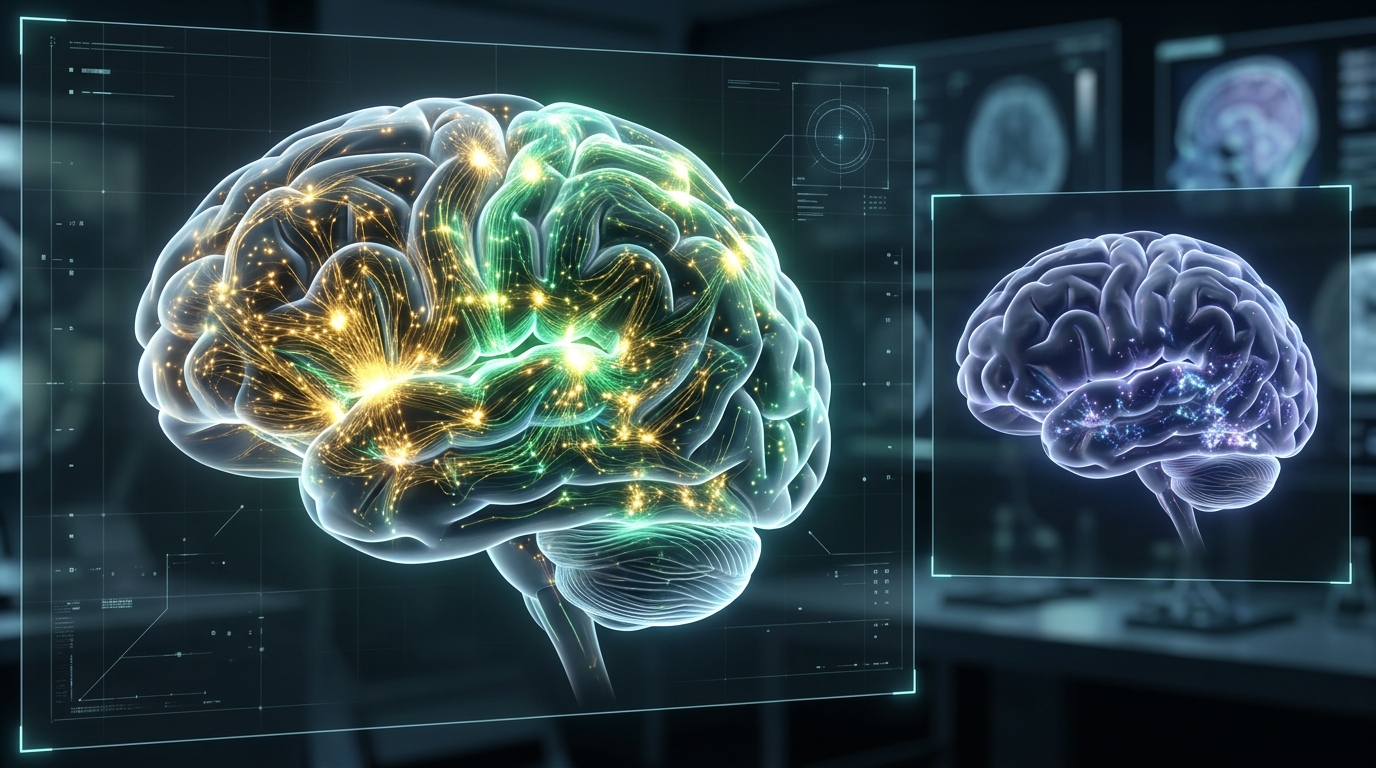
Does this mean handwriting has no scientific value? Far from it. Cutting-edge neuroscience has unveiled the remarkable cognitive stimulation uniquely triggered by the act of writing with a pen.
In a landmark study conducted at the Norwegian University of Science and Technology (NTNU) by Professor Audrey van der Meer and colleagues (van der Meer et al., 2024, Frontiers in Psychology), researchers utilized high-density 256-channel EEG caps to compare brainwave dynamics when subjects typed on keyboards versus when they wrote with digital styluses.
The results revealed that handwriting with a pen produced dramatic, widespread synchronization of theta (4–8 Hz) and alpha (8–12 Hz) brainwaves across the parietal lobe and sensorimotor cortex—neural patterns recognized as vital for synaptic consolidation and learning.
Unlike pressing uniform keyboard keys or gliding eyes over text, stylus handwriting coordinates intricate tactile pressure, pen angle adjustments, and real-time visual-spatial feedback. This multisensory integration activates vast cerebral networks, embedding durable memory traces (engrams) that resist decay.
Visual vs. Kinesthetic Learners: Strategic Hybrid Study Protocol
Learners frequently identify as "visual learners" who absorb diagrams quickly or "kinesthetic learners" who prefer moving their hands. However, top-performing students do not limit themselves to personal preferences.
Instead, elite learners strategically allocate study modalities based on item difficulty and testing formats:
1. Optimal for 'Reading/Viewing': Multiple-choice exams, broad historical timelines, abstract conceptual overviews, and high-speed reviews of already familiar terms.
2. Essential for 'Handwriting': Exact spelling of foreign vocabulary, complex kanji and non-Latin scripts, mathematical derivations, legal case titles, and difficult terms that repeatedly fail recognition.
Attempting to write out every fact consumes unsustainable amounts of time. Conversely, relying only on reading risks failure on written exams. Combining fast visual sweeps with surgical handwriting drills for core choke points is the gold standard of high-efficiency study.
| Dimension | Mindless Handwriting (Copying / Rote Drills) | Active Recall Handwriting (Science-Backed) |
|---|---|---|
| Visual Gaze | Looking at the textbook while copying onto paper | Focusing solely on paper, pulling data from memory |
| Retrieval Strain | Zero (Illusion of fluency; shallow clerical work) | Maximum (Hippocampus & parietal lobe fully engaged) |
| Repetition Protocol | Writing the same item 10 times consecutively | Write once from memory; retest after time intervals |
| Exam Reproducibility | Vaguely familiar, but cannot write accurately | Reflexive recall with zero spelling hesitation |
| Time-Efficiency ROI | Poor (High physical fatigue, low retention) | Superior (Minimal writing, permanent memory consolidation) |
Science-Backed Handwriting Memorization & App Protocols
To unleash the true power of handwriting, you must immediately abandon student-era habits of mechanically filling notebook lines. Here is an actionable, high-yield handwriting protocol grounded in cognitive psychology.
The Power of Active Retrieval Handwriting Tests Without Looking
The golden rule of high-retention handwriting is uncompromising: "Hide the answer completely and retrieve it before writing."
As proven by Dr. Jeffrey Karpicke and Dr. Henry Roediger at Purdue University (Karpicke & Roediger, 2008, Science), long-term retention does not occur when information is ingested (input); it occurs when the brain strains to retrieve information (output).
When viewing a prompt, resist peeking at the solution. Pause for 3 to 5 seconds to actively search your memory banks before committing letters to paper or screen. This cognitive struggle is precisely when synaptic plasticity is stimulated.
Furthermore, penmanship does not need to be neat. Fast scribbles that only you can decipher are completely sufficient. Obsessing over penmanship drains cognitive bandwidth that should be reserved for memory retrieval. "Quick retrieval, rapid writing, instant feedback"—this rhythmic velocity is the hallmark of effective handwriting study.
The 'Blank Canvas Output Method' to Master Spelling & Terminology
To eradicate spelling lapses and character errors, I train high school students using the "Blank Canvas Output Method" (a tactile evolution of the Blurting Method):
1. Select 10 to 20 target terms or vocabulary words from your syllabus.
2. Look only at the prompts or definitions, writing the target terms onto blank paper completely from memory.
3. If you get stuck, do not peek at the answer key. Squeeze out whatever letters or radical parts you can recall.
4. After completing the set, compare against the answer key. Highlight the exact miswritten letter or stroke in bold red or blue.
This protocol brutally exposes the exact boundary between words you have genuinely mastered and words you merely recognize. Staring at an open book fosters comfortable complacency, but a blank canvas demands full accountability. That emotional spark of recognizing a knowledge gap activates the amygdala, dramatically accelerating subsequent retention. Learn more in our Blurting Study Hack Guide.
Eliminating Paper Friction: Smart Tablet & Smartphone Handwriting
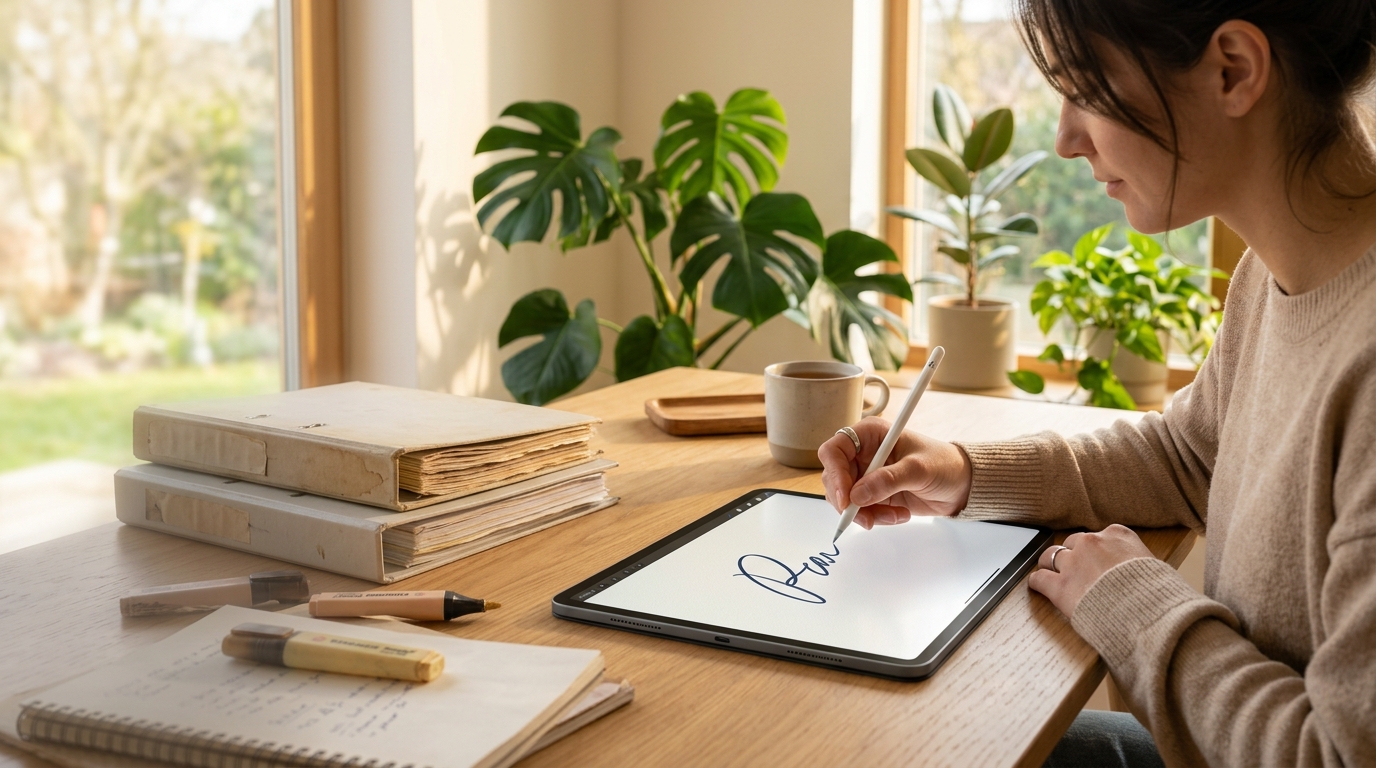
Historically, the primary barriers to handwriting were the friction of physical tools and the impossibility of managing spaced review intervals manually.
"I wanted to study, but couldn't find a notebook," "Finding scrap paper was annoying, so I procrastinated," or "The notebook where I wrote my mistake list went missing"—these micro-frictions steadily erode study habits.
Digital handwriting on tablets (iPad, Android) or smartphones completely eliminates this friction. Using a stylus (such as the Apple Pencil) or a fingertip on a digital canvas produces no eraser shavings and requires zero paper shopping. A single tap clears the canvas for infinite retrieval drills. Eliminate physical friction so 100% of your mental focus goes straight into memory consolidation.
Direct Screen Writing: Inside PathMemoria's New Handwriting Mode

"I want to write digitally, but existing flashcard apps only offer typing or basic card flipping..."
"Some apps feature handwriting, but inaccurate AI handwriting recognition marks correct answers as wrong, causing immense frustration..."
To resolve these long-standing pain points, the next-generation memory platform PathMemoria officially released its highly anticipated "Handwriting Mode (Write Mode)" in September 2026!
PathMemoria's Handwriting Mode is meticulously designed for high-performance academic learning:
- Expansive Canvas & Square Grid Guides: Accommodates complex Asian characters, chemical formulas, and long foreign vocabulary with generous margins. Native palm rejection ensures natural, paper-like writing comfort on tablets.
- Stress-Free Self-Evaluation: Eliminates AI misrecognition frustration completely. Tapping "Show Answer" expands the correct solution and comprehensive explanations above your handwriting, letting you accurately self-assess stroke by stroke.
- Seamless FSRS Spaced Repetition Integration: Every handwritten review is processed by the state-of-the-art FSRS v6 algorithm, automatically scheduling subsequent retests at the exact moment before memory fades.
- Blank Canvas Guard & Handwriting Effort Bonus (+2 XP): Built-in protection prevents submitting blank screens. Furthermore, actively engaging motor circuits earns an extra +2 XP effort bonus, accelerating your daily motivation.
Desk Handwriting vs. Commute Quiz: Seamless Study Mode Switching
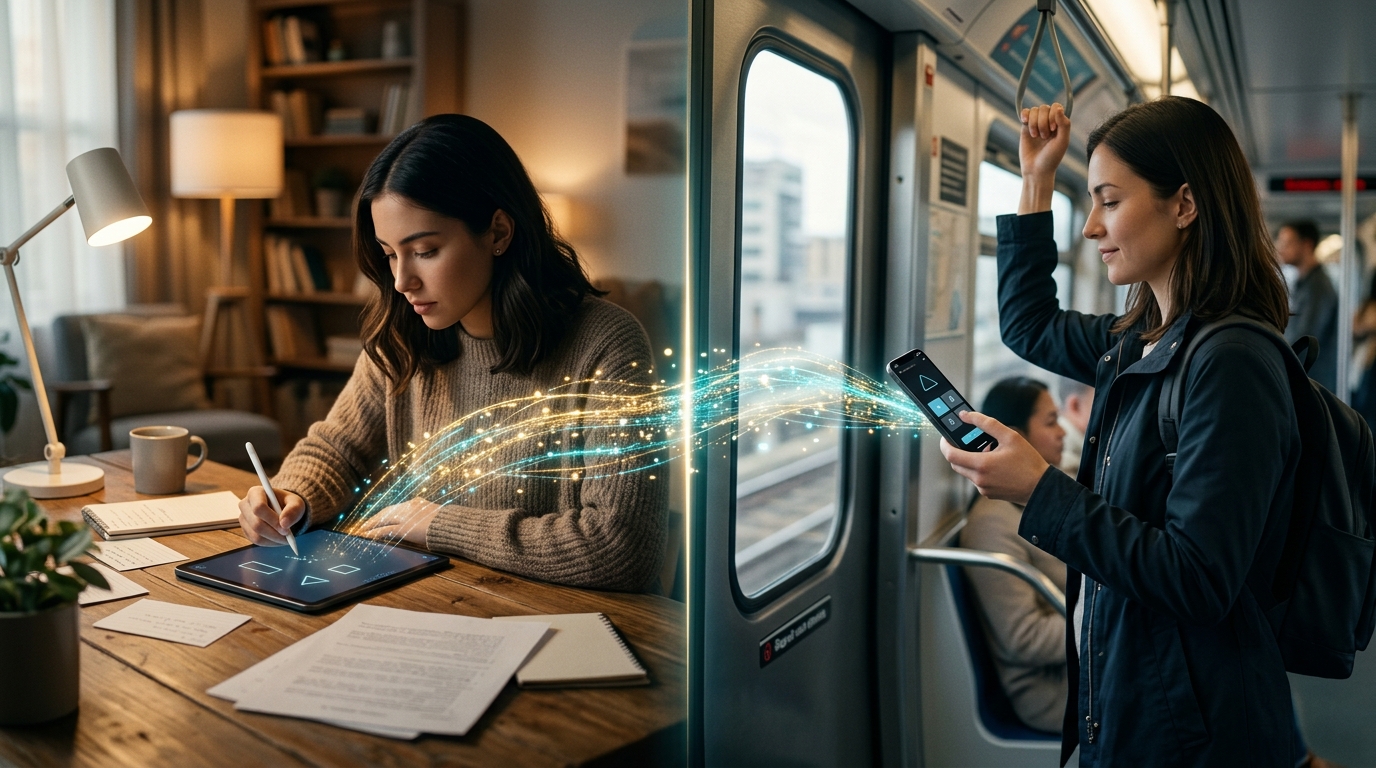
"I understand handwriting stimulates the brain, but I cannot hold a stylus on a crowded subway or bus..." That is entirely natural. Dedicated desk time is precious and limited.
The decisive advantage of modern learners is "seamless mode switching."
Within PathMemoria, you can toggle your active study mode instantly across "Handwriting (Write)", "Card Flip", "4-Choice Quiz", and "Voice Autoplay (Audio)" with a single tap on the deck header:
- At Your Desk (Home / Library / Cafe): Select "Write Mode". Utilize your stylus to engage deep sensorimotor networks for exact spelling and complex term mastery.
- On Transit (Subways / Buses): Switch to "Quiz Mode" or "Flip Mode". Complete high-speed recognition drills with one thumb on a crowded train.
- Walking to the Station or Doing Chores: Put in earbuds and launch hands-free "Voice Autoplay (TTS)". Listen to prompts, retrieve answers mentally during pauses, and reclaim transit gap time without looking at the screen.
All review metrics flow into a unified FSRS forgetting curve database regardless of study mode. This hybrid agility is how ambitious modern learners pass difficult exams in record time. For audio setup, check our Voice Autoplay Guide.
Summary: Master Active Handwriting Memorization for Exam Success
Handwriting was never outdated or inefficient. What was inefficient was passive transcription. Active retrieval handwriting—pulling facts from memory and forming letters with intention—remains one of the most powerful memory consolidation tools in cognitive science.
Remember the four golden principles for your daily routine:
1. Stop copying from textbooks; always hide the answer and retrieve facts onto blank paper.
2. Stop writing the same word ten times; write once from memory and immediately analyze mistakes.
3. Eliminate paper and tool friction by adopting digital tablet and smartphone handwriting canvases.
4. Switch modalities dynamically: handwriting at your desk, 4-choice quizzes and audio during transit.
With the right scientific protocol, not a single stroke of your effort is wasted. Leverage PathMemoria's new Handwriting Mode to etch knowledge directly from fingertip to synapse, and conquer your target exams!
Q1. What is the primary neuroscientific reason why transcribing text while looking at a book is ineffective?
- A. It rapidly consumes pen ink without visual rewards
- B. It exerts zero retrieval load to pull facts from memory, so the hippocampus discards it as shallow noise
- C. Beautiful handwriting overstimulates creative brain regions and halts logical processing
View Correct Answer & Explanation
Correct Answer: B
Looking at a textbook while writing merely routes visual input through motor nerves. Because the hippocampus experiences no active recall strain ("What was that word again?"), the brain assumes the information is readily available in the environment and refuses to form lasting synaptic engrams.
Q2. According to the 2024 NTNU brainwave study, what neural mechanism makes stylus handwriting superior to typing for deep memory?
- A. Handwriting raises body temperature, which burns excess brain glucose
- B. Typing on uniform keys causes severe visual fatigue across the frontal cortex
- C. Multisensory coordination of pen pressure, angle, and shape dynamically synchronizes theta and alpha waves across parietal and sensorimotor networks
View Correct Answer & Explanation
Correct Answer: C
Van der Meer et al. (2024) demonstrated via 256-channel EEG that stylus handwriting stimulates widespread theta and alpha wave connectivity across parietal and sensorimotor areas. This multisensory integration embeds far deeper memory traces than uniform key presses.
- Step 1:Launch PathMemoria in your browser to try the new Handwriting Mode in 10 seconds for free
- Step 2:Stop copying from open books; always hide answers and write from memory onto a blank screen
- Step 3:Verify spelling using stress-free self-evaluation and highlight tricky character mistakes
- Step 4:Switch to 4-choice quiz mode or hands-free Voice Autoplay during daily commute gap times
- Step 5:Let the FSRS algorithm automate your review queue right before memories begin to fade
• Blurting Method Study Hack: Science-Backed Active Recall Protocol
• Best Flashcard Apps Compared: Free, AI & Spaced Repetition Tools
• Ultra-Efficient Memorization for Working Adults: Certification Mastery
• Study Modes Masterclass: Flip, Quiz, Audio & Handwriting Workflows
• Hands-Free Audio Flashcard Learning: Commute Gap-Time Mastery
• Excel Flashcard Import Guide: 1-Second Setup & Free Template
Experience Zero-Friction Handwriting Memorization in 10 Seconds
Say goodbye to messy paper notebooks and frustrating AI misrecognition. Try PathMemoria's new Handwriting Mode on your iPad or smartphone for free today!
![[2026 Guide] The Blurting Method: Skyrocket Memory Retention with Active Recall & AI](https://pathmemoria.tsmichi.com/blog/blurting_h3_tiktok_viral.jpg)