Hello, I am Taku, a high school teacher and memory software developer.
"I spend hours highlighting textbooks, but by the next day, everything has evaporated..."
"I spent an entire weekend crafting meticulous, colorful summary notes, yet on exam day my mind went completely blank..."
"I crammed all night before the test, only to freeze the second I sat down at my desk..."
Mentoring college-prep students in honors courses and studying independently for rigorous IT and financial certifications while teaching, I hear these exact frustrations on a weekly basis. Dedicated, hardworking learners often end up blaming themselves: "I must just lack innate intelligence," or "I was born with a poor memory."
However, as both a classroom educator and a cognitive system architect, let me reassure you: Your inability to retain information is NOT due to a lack of talent, intelligence, or willpower. The root cause lies entirely in outdated, passive study habits (mindless re-reading and note copying) that directly violate how the human brain—specifically the hippocampus—naturally filters and consolidates memory.
By biological default, the human brain is hardwired to forget. If our brains retained every single sensory impression encountered each day, our neural circuits would burn out in minutes. To force the brain to recognize specific facts as essential survival knowledge, there is a precise neurobiological protocol that governs recall effort and review spacing.
In 2026, the intersection of cognitive psychology and educational technology has transformed memorization from grueling willpower battles into reproducible, automated science.
In this master guide, I will deconstruct the structural flaws of passive studying from a neuroscience perspective, unpack the five core protocols of science-backed memorization, and provide an actionable roadmap combining Google's latest Gemini AI with the state-of-the-art FSRS v6 algorithm to help you achieve effortless long-term retention!
- •The Neuroscience of Forgetting: Why textbook re-reading and summary notes yield a miserable 35% retention rate
- •The Two Giants of Cognitive Science: How Active Recall and Spaced Repetition (FSRS) multiply memory durability by 2.4x
- •Five Core Memorization Protocols: Mastering blurting, elaboration, chunking, audio retrieval, and sleep consolidation
- •Zero-Effort Automation with AI: How Google Gemini and CSV spreadsheets eliminate manual card-making entirely
Why Does Your Memorization Fail? 4 Brain Myths and the Passive Learning Trap
Over 90% of dedicated students struggling with poor exam retention make the same fatal mistake: they choose study methods that fight against human biology. Let us examine the cognitive mechanisms behind why traditional brute-force studying collapses under real testing conditions.
- 1. Re-Reading Textbooks Repeatedly: Creates visual familiarity, tricking the brain into feeling mastery while synaptic encoding remains zero.
- 2. Meticulous Summary Notes: Merely transcription therapy that provides zero practice in actively retrieving answers from memory.
- 3. All-Night Cramming Sessions: Skips the critical sleep phase where the hippocampus transfers temporary memories into the cerebral cortex.
- 4. Rote Memorization of Similar Facts: Without structural contrast, memory interference causes facts to scramble during high-stress exams.
The Brain is Hardwired to Forget: Passing the Hippocampal Security Filter

Every piece of information absorbed through our eyes and ears first arrives in the hippocampus, the brain's temporary storage gateway.
The hippocampus functions as an ultra-strict security guard. If our brains permanently recorded every trivial detail encountered each day, our metabolic energy would deplete immediately. Consequently, the hippocampus purges over 95% of incoming inputs within 48 hours as "useless cognitive clutter."
What signal convinces the hippocampus that a concept is vital for survival and should be encoded into permanent cerebral cortex storage?
The single decisive factor is how frequently and effortfully that information is retrieved from within the brain (retrieval practice).
Passively reading a textbook appears to the hippocampus as harmless scenery passing outside a train window. However, the moment you close the book and struggle to recall the facts from memory, Long-Term Potentiation (LTP) is triggered across your synaptic junctions. The only way to deceive the brain into remembering is through the effort of active recall.
The Trap of Summary Notes and Highlighters: The Fluency Illusion Exposed
The most popular study habits—color-coded highlighting and transcribing textbook summaries—are among the least productive.
In a comprehensive meta-analysis evaluating ten learning techniques, Professor John Dunlosky and colleagues (Association for Psychological Science, 2013) rated textbook re-reading and highlighting as having "Low Utility" for academic performance.
The culprit is a cognitive bias known as the Fluency Illusion.
When you read highlighted sentences or write clean notes with the textbook open in front of you, the material feels effortless to process. The brain mistakenly confuses this reading fluency with actual mastery. Yet when the textbook is closed on exam day, you realize zero neural connections were established.
In landmark research published in Science (2008) by Dr. Jeffrey Karpicke, students who read word lists four times retained only 35% after one week. In stark contrast, students who engaged in active retrieval testing achieved roughly 80% retention.
Spending three hours rewriting textbook notes is clerical busywork that produces almost zero long-term memory traces.
Why All-Night Cramming Collapses in 72 Hours: Lack of Sleep Consolidation
Relying on all-night study marathons before a major exam is an evolutionary dead end.
During wakefulness, information is temporarily staged in the hippocampus. It is during deep sleep (slow-wave non-REM sleep) that memories are physically consolidated into the neocortex.
Neuroimaging research demonstrates that during deep sleep, the brain experiences "memory replay." Neural pathways activated during daytime study fire repeatedly at high speed, binding synapses into permanent engrams.
Cutting sleep to cram information is the biological equivalent of downloading a massive 50GB file onto a computer and pulling the power cord before hitting "Save." While you might recognize snippets during the morning exam, within three days the temporary hippocampal cache is purged, leaving your brain empty.
True mastery treats sleep not as a break from learning, but as the essential second half of the memorization process. For details, review our guide on Sleep & Memory Consolidation Neuroscience.
Why Similar Concepts Scramble: The Reality of Memory Interference
Have you ever confused similar vocabulary words or legal clauses during an exam?
Cognitive psychology explains this through Memory Interference Theory. Interference occurs in two forms: Proactive Interference (prior knowledge hinders new learning) and Retroactive Interference (new learning damages recall of previously mastered facts).
Interference happens when multiple similar facts are memorized as isolated symbols without clear distinguishing frameworks. The brain's indexing system gets confused, pulling the wrong card from the mental drawer.
To neutralize interference, learners must structure contrasting facts into explicit comparison matrices, exploring conceptual distinctions through elaborative rehearsal rather than rote repetition. Learn more in our Interference Theory Protocol.
The 5 Core Science-Backed Memorization Protocols & AI Roadmap
Once you understand how the human brain processes information, the path to academic mastery becomes remarkably clear. Here are the five core protocols validated by international cognitive science:
| Cognitive Protocol | Scientific Foundation | Retention Impact | Practical Tool |
|---|---|---|---|
| ① Active Recall | Karpicke et al. (Science, 2008) | Retention jumps from 35% to 80% | Blurting / Spaced Flashcard Apps |
| ② Spaced Repetition | FSRS v6 / Ebbinghaus (1885) | Cuts review volume by 30% while holding 90% retention | PathMemoria FSRS Automated Engine |
| ③ Elaborative Rehearsal | Craik & Lockhart (1972) | Builds durable semantic networks | Feynman Technique / Gemini AI Tutor |
| ④ Chunking & Dual-Coding | Cowan (2001) / Paivio (1971) | Compresses cognitive load by 3x | Image Occlusion (Masking) |
| ⑤ Audio Recall & Power Naps | NASA Fatigue Studies / NIH Research | Turns commute into study; restores hippocampus | Voice Autoplay TTS / 20-Min Nap |
Protocol 1: Blank-Paper Blurting: Multiplying Retention by 2.4x
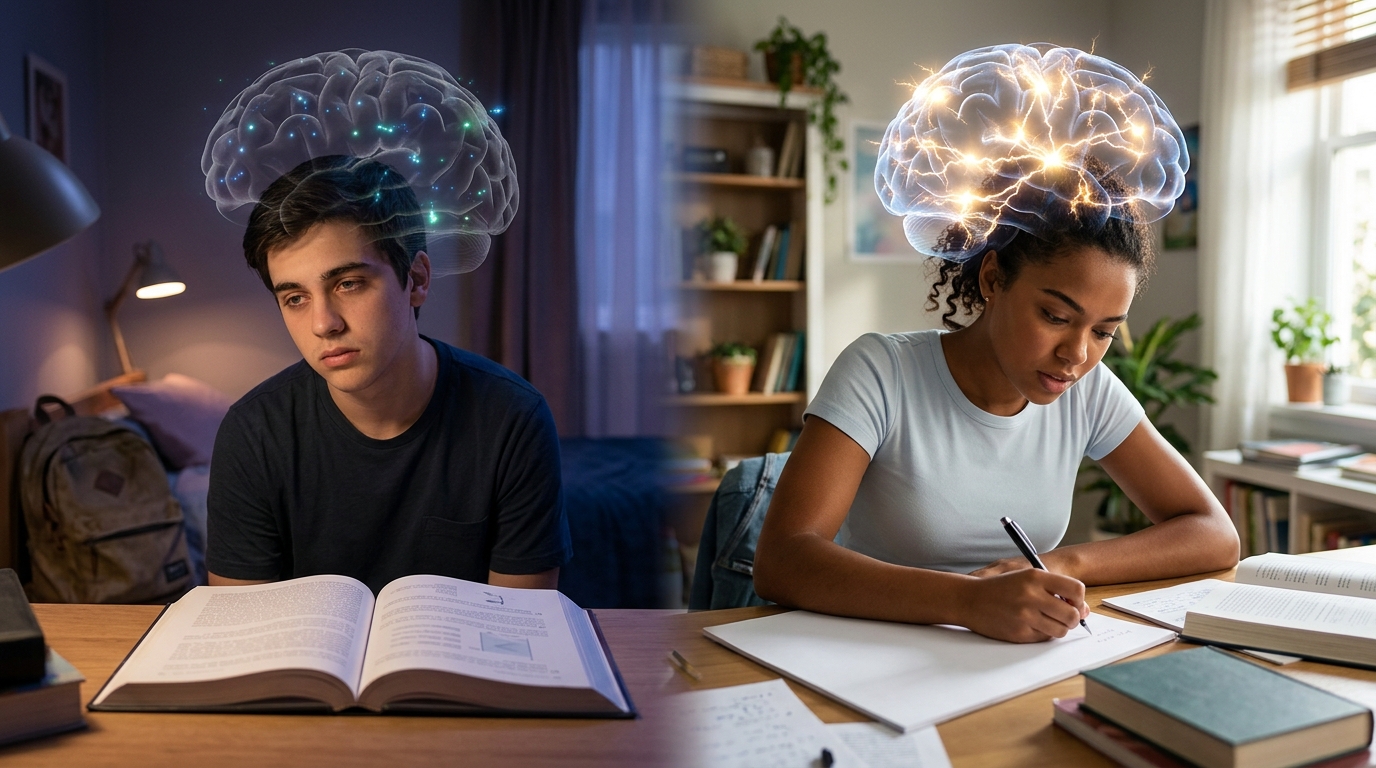
The golden rule of scientific study is: Limit input (reading/listening) to 30% of your time, and dedicate 70% to active recall (retrieval practice).
The most powerful analog technique is the Blurting Method. Read a 2-page textbook section with intense focus. Then, completely close the book. Take a blank sheet of paper, start a 3-minute timer, and jot down every definition, diagram, and equation you can remember from memory.
Once time expires, open your textbook and use a red pen to mark what you missed or misstated. This immediately illuminates your exact memory voids. Rather than reviewing what you already know, you target only the red annotations.
As UCLA psychologist Robert Bjork proved with his "Desirable Difficulties" framework, the cognitive strain of recalling information is the precise trigger that thickens synaptic connections. Read our Complete Blurting Method Guide for full details.
Protocol 2: FSRS v6 Spaced Scheduling: Cut Review Load by 30%
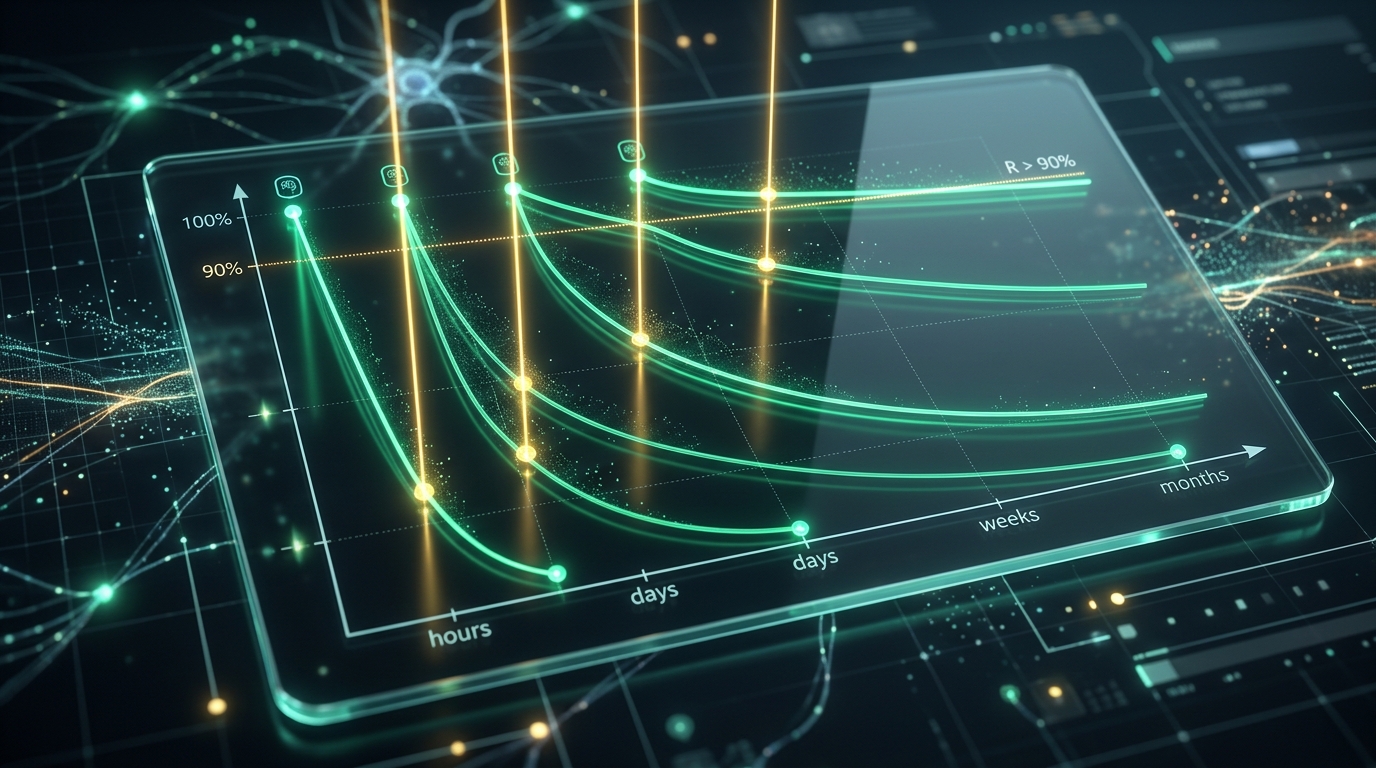
Transforming facts into lifelong memories requires Spaced Repetition (Distributed Practice).
Ebbinghaus demonstrated that recall decays rapidly within 24 hours. However, reviewing a card at the golden threshold where retrievability drops to roughly 90% resets the curve and multiplies memory stability.
Older spaced repetition tools relied on rigid schedules or outdated 1987 algorithms (SM-2) that caused brutal backlogs (Ease Hell). Modern cognitive computing has resolved this with FSRS v6 (Free Spaced Repetition Scheduler).
FSRS tracks Stability (S), Difficulty (D), Retrievability (R), and Elapsed Time (t) independently for every card. By serving reviews at the optimal moment, FSRS reduces daily review workload by approximately 30% compared to legacy software while guaranteeing 90%+ exam retention. Learn more in our Forgetting Curve Review Timing Guide.
Protocol 3: Elaborative Rehearsal: The Feynman Technique
According to Craik & Lockhart's (1972) Levels of Processing framework, shallow repetition produces fragile memory traces. To anchor concepts into the cortical network, you must practice Elaborative Rehearsal.
The most elegant implementation is the Feynman Technique, pioneered by Nobel laureate Richard Feynman:
Explain the concept out loud using plain language, as if teaching a 10-year-old middle school student, without using jargon.
The moment you struggle to explain a concept without reciting textbook terms, you locate your conceptual blind spots. Forging logical cause-and-effect narratives anchors concepts into durable mental schemas. Explore our tutorial on The Feynman Technique & Spaced Repetition.
Protocol 4: Chunking & Image Occlusion: Dual-Coding
Cognitive psychologist Nelson Cowan (2001) proved that working memory can hold only 4±1 chunks of information at once. Memorizing twenty isolated facts instantly overloads your mental bandwidth.
Overcome this limit using Chunking—grouping related facts into structured hierarchies. Furthermore, leverage Allan Paivio's (1971) Dual-Coding Theory, which proves the brain encodes verbal and visual spatial memories along separate channels.
With Image Occlusion (Image Masking), you photograph anatomical charts, financial statements, or history maps, placing interactive digital masks over key labels. Tapping to test recall triggers verbal and visual networks simultaneously, tripling retention speed. See our Digital Marker & Image Occlusion Guide.
Protocol 5: Commute Audio Recall & 20-Minute Power Naps
Busy learners often struggle to find large blocks of uninterrupted study time. Yet daily commutes and chores offer 1 to 2 hours of untapped cognitive auditory time.
Use Voice Autoplay (TTS) to turn commutes into an active retrieval gym. Earphones speak the prompt, pause for 2.5 seconds to let you mentally retrieve the answer, and then play the explanation—entirely hands-free.
When mental fatigue strikes in the afternoon, take a 20-minute Power Nap. As confirmed by NASA aviation fatigue research, a 20-minute nap purges adenosine from the brain, resetting hippocampal capacity and restoring morning-level learning capacity. Explore Voice Autoplay Audio Memorization and Power Naps for Learning.
Protocol 6: Google Gemini AI & Excel Batch Card Generation
The greatest friction in digital flashcard study is the exhausting labor of typing prompts manually. Because typing has zero memory retention benefit, spending hours keying in data is a massive waste of study time.
In 2026, this bottleneck is solved through Generative AI and spreadsheet workflows.
Powered by Google's cutting-edge Gemini AI, entering an exam syllabus or snapping a photo of textbook pages instantly produces comprehensive, high-yield flashcard decks with clear explanations in seconds.
Furthermore, maintaining term lists in Excel or Google Sheets allows you to export a 3-column CSV file (Prompt, Answer, Explanation) and drag-and-drop 1,000+ cards into your digital deck in literally 1 second. Reclaim your time from clerical data entry and invest 100% of your energy into active retrieval practice. Review our AI Flashcard Generation Tutorial and Excel CSV Bulk Import Guide.
- •A) The number of times students carefully re-read the textbook with highlighters.
- •B) The frequency of active retrieval testing (actively recalling facts from memory).
- •C) The aesthetic layout and color variety of student summary notebooks.
- •A) It forces learners to review all cards 10 times daily regardless of difficulty.
- •B) It dynamically evaluates card stability to serve reviews at the 90% retention threshold, slashing review volume by 30%.
- •C) It automatically deletes any card not reviewed within seven days.
Summary: Master Science-Backed Memorization and Achieve Exam Victory
Memorization is never a lottery of genetic memory talent. It is an engineering discipline governed by whether you align your habits with the brain's biological rules—Active Recall and Spaced Scheduling.
Follow this 5-step action checklist to revolutionize your study routines starting today:
- ☑ Step 1: Stop re-reading and note copying; invest 70% of study time into active retrieval testing.
- ☑ Step 2: Close the textbook and practice 3-minute blank-paper blurting after each chapter.
- ☑ Step 3: Simplify challenging terms with the Feynman Technique, explaining them in plain terms.
- ☑ Step 4: Automate card creation using Google Gemini AI batch tools and 1-second CSV imports.
- ☑ Step 5: Rely on automated FSRS v6 scheduling to manage your review queues with zero mental overhead.
Developed by a high school educator, PathMemoria natively integrates every protocol covered in this guide: automated FSRS v6 scheduling, Google Gemini AI deck generation, 1-second CSV importing, Image Occlusion, and Hands-Free Voice Autoplay.
Experience effortless, science-backed learning by starting your free trial in 10 seconds. Free yourself from the misery of rote cramming today!