
Hello everyone, I'm Teacher Taku. When preparing for critical examinations, standardized admissions, or professional licensing tests, have you ever felt determined to build an "ideal study plan," filling your planner or calendar with rigid hourly quotas—only to watch unexpected life events or fatigue derail your schedule within days, leaving you paralyzed by self-blame and eventually abandoning the plan entirely?
Over my two decades coaching thousands of students and adult candidates in the classroom, I have witnessed this heartbreaking cycle repeatedly. Here is the vital truth: falling behind on a study schedule is NEVER a flaw in your willpower or character. Traditional planning advice—such as "study 20 pages every single day" or "block every waking hour"—violates fundamental cognitive psychology and behavioral economics, making failure almost inevitable.
In accordance with modern self-directed digital learning guidelines from the U.S. Department of Education emphasizing resilient self-regulated learning, elite candidates do not rely on rigid perfectionism. Instead, they operate dynamic reverse systems engineered to absorb disruption. Grounded in behavioral science and cognitive psychology, this guide reveals the science-backed blueprint for study planning that guarantees victory without burnout!
- •The hidden psychological biases that cause 90% of study plans to collapse.
- •Why rigid daily page targets backfire and how to shift to task-based mastery.
- •The 3-stage reverse scheduling protocol backcasted from your target exam deadline.
- •How weekly buffer days and FSRS forgetting curve AI automate review quotas effortlessly.
How to Design a Resilient Study Plan That Never Fails
The Overpacked Schedule Trap Where 90% of Learners Fail
The single most destructive error learners make when formulating study plans is calibrating quotas against an imaginary "ideal self." In moments of peak inspiration, ambitious students draft hyper-dense schedules: "Four hours every weekday, eight hours every weekend," or "Ten textbook pages daily without fail." Yet classroom observations reveal that students who jam every planner grid with dense text almost universally abandon their schedules within seven to ten days.
The root flaw is failing to account for inevitable real-world friction: sudden fatigue, family obligations, work overtime, or encountering a concept that demands three times longer to unpack than anticipated. An overpacked calendar is a fragile house of cards where one delay causes systemic collapse. An authentic study plan must never serve as an idealized wish list; it must function as a resilient risk-management architecture built to protect your passing score under stressful circumstances.

The Planning Fallacy & The Dangerous 'What-the-Hell' Effect
Why do even brilliant minds repeatedly succumb to unrealistic planning? Groundbreaking behavioral economics research by Nobel laureate Daniel Kahneman and Amos Tversky (Kahneman & Tversky, 1979) identified the Planning Fallacy: an innate cognitive bias where individuals underestimate the time, costs, and risks of future tasks while overestimating future stamina, even when past experience contradicts that optimism.
Compounding this bias is a toxic psychological trap known as the 'What-the-Hell Effect'. The moment a learner falls behind schedule by even a single day, an all-or-nothing mindset takes over: "My perfect schedule is ruined, so what the hell, why bother studying at all today?" Abandoning the plan is rarely about laziness; it is the predictable collision of these two neurological vulnerabilities. Recognizing these cognitive traps is your first shield against demoralization.
Why Rigid Daily Page Quotas Sabotage Conceptual Mastery
Assigning rigid daily quotas—such as "Monday: Pages 20-30, Tuesday: Pages 31-40"—is a recipe for superficial learning. Across academic syllabi and certification manuals, information density is never uniform. Five pages covering introductory definitions might take fifteen minutes, whereas five pages detailing complex tax formulas or organic chemistry mechanisms could require two hours of deep cognitive strain.
When daily targets are chained to page counts, students fixate entirely on finishing the pages rather than mastering the material. They rush through explanations and mindlessly copy answers to mark tasks complete, falling victim to the illusion of competence. Shift away from rigid pages or clock hours, organizing your calendar around discrete conceptual outcomes: "Master the physiological role of organ systems" or "Solve and review five past exam questions." In our Adult Qualification Exam Guide, this outcome-driven model proves vital for working professionals.
Fueling Daily Habit Formation with If-Then Implementation Intentions
Relying on sheer motivation to start studying at a designated time—such as "I will sit down and study at 7:00 PM"—is exceptionally fragile. Mental willpower is an exhaustible resource heavily depleted by daily stress. To bypass procrastination effortlessly, cognitive psychologist Dr. Peter Gollwitzer engineered If-Then Planning (Implementation Intentions).
Instead of relying on conscious decisions, you hardcode behavioral triggers into pre-existing daily routines: "If I finish dinner and clear my plate (If), then I will immediately open my flashcard app and review ten cards (Then)." Or: "If the train doors close during my morning commute (If), then I will press play on my audio flashcard deck (Then)." As detailed in our If-Then Planning Habit Guide, linking study actions to automatic environmental cues reduces startup friction to zero.
Reset Protocol: How to Recover When Your Schedule Derails
Here is the definitive answer to schedule disruption: Never attempt to double your workload the next day to catch up. Cut your losses immediately, accept the delay without guilt, and recalibrate your remaining timeline from your current baseline.
Attempting marathon cramming sessions over the weekend to compensate for missed weekday goals damages sleep quality, spikes cortisol, and creates an even worse backlog the following week. Falling behind simply proves your initial time estimates were overly aggressive. Pivot gracefully: roll overdue items into your scheduled weekly buffer day, or prune low-priority practice problems to safeguard core exam concepts. This rapid recalibration is what separates resilient achievers from chronic abandoners.
Reverse Scheduling Protocols to Guarantee Exam Victory
3-Stage Reverse Milestones Backcasted from Your Exam Date
Top-tier test takers do not plan forward from today; they plan backward from the examination date using a 3-stage reverse milestone strategy. Learners who study forward without deadlines frequently run out of runway, arriving at the final month having barely touched actual past exam questions.
The golden reverse framework follows three synchronized phases: ① Lock in the final 4 to 8 weeks exclusively for "Past Paper Simulation & Diagnostics" ➔ ② Backcast the preceding middle phase for "Active Retrieval Question Drills" ➔ ③ Assign the remaining initial runway for "Foundational Concept Input." Working backward establishes hard deadlines for finishing initial theory, generating healthy, motivating urgency that keeps daily work purposeful.

Automating Spaced Review Schedules with Forgetting Curve AI
The single greatest operational bottleneck in study planning is determining when and how frequently to review past material. Advancing through new chapters while neglecting past topics guarantees that concepts studied a month ago vanish from memory. Yet manually charting future review dates in planners across hundreds of vocabulary terms and formulas is mathematically impossible.
Overcoming this complexity requires synchronizing with cognitive science principles from our Forgetting Curve Timing Guide and automated algorithms. In the next-gen memory application PathMemoria, the built-in Free Spaced Repetition Scheduler (FSRS) features an intelligent Target Date Countdown Engine. Simply enter your exam date, and the AI computes daily retention decay, serving the exact cards requiring review each morning. Delegating schedule mechanics to AI leaves your cognitive energy completely free for deep learning.

The Weekly Buffer Day: Protecting Your Psychological Safety
The indispensable linchpin of a bulletproof weekly schedule is dedicating one full day each week—with zero new assignments—as a designated "Buffer Day." Eager learners frequently schedule seven days of uninterrupted study, which functions like driving on a highway without brakes.
| Day Window | Core Learning Allocation | Strategic Function | Key Failure Prevention Tip |
|---|---|---|---|
| Monday - Friday | Standard topic progress + daily app spaced review quotas | Consistent momentum & spaced retrieval | Protect minimal review sessions even during exhausting work shifts |
| Saturday | Extended deep work blocks & past exam simulations | High-level problem solving & diagnostic testing | Apply Pomodoro Technique (25m drill / 5m rest) to maintain stamina |
| Sunday (Recommended) | 【Dedicated Buffer Day】 Absorb weekday backlog & weekly reflection | Psychological safety net | If backlog is clear, enjoy guilt-free rest to refresh neural dopamine |
Knowing you have an open Sunday buffer removes panic when unexpected weekday delays occur, insulating you from the demoralizing What-the-Hell Effect. When your weekday targets finish cleanly, Sunday becomes pure restorative leisure. This balance provides the emotional stamina necessary to sustain months of exam preparation.
Microlearning Hacks: Harnessing Commute & Gap Time
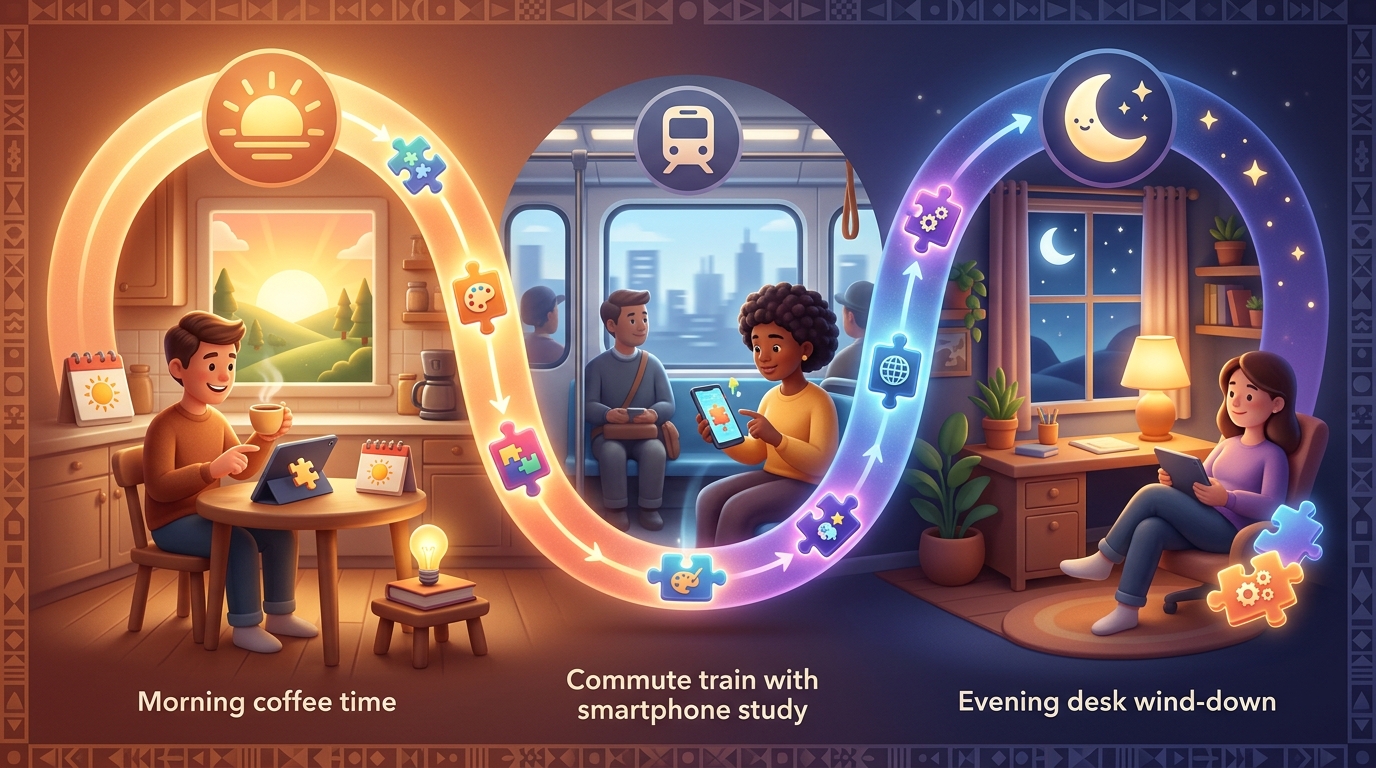
Working adults and busy students often complain that lacking two-hour unbroken study blocks prevents them from maintaining study plans. However, limiting study time strictly to a formal desk misses a goldmine: commuter trains, queue lines, waiting rooms, and evening wind-down minutes provide one to two hours of untapped daily gap time.
Structure your schedule by bifurcating tasks: reserve desk hours for "heavy cognitive work" (writing essays, analyzing past exams), and delegate "light retrieval tasks" (flashcards, term drills, audio listening) entirely to microlearning windows. As highlighted in our Microlearning Gap Time Guide, using PathMemoria's voice autoplay and mobile drills to clear memory quotas on the go allows you to sit at your desk in the evening focused solely on high-value practice.
Summary: Master Science-Backed Study Planning to Conquer Your Goals
A study plan is never a punitive straitjacket designed to induce guilt. It is an empowering navigational compass steering you calmly toward your target goal. Achievers who cross the finish line are not those who execute an inflexible plan flawlessly; they are those who accept cognitive human fallibility, embrace buffer days, and adapt gracefully to life's inevitable detours.
Begin right now: eliminate arbitrary page quotas from your calendar, schedule an open buffer day this weekend, and offload your review scheduling to an algorithmic system like PathMemoria. When your daily effort is guided by sound cognitive science, your hard work will never go to waste. Step into your reverse schedule today, and claim the exam score you deserve!
📝 [Check Quiz 1] Identifying Cognitive Planning Traps
[Question] What innate cognitive bias causes learners to consistently underestimate the time required to complete future academic tasks?
💡 View Answer & Explanation
[Answer] The Planning Fallacy.
[Explanation] Coined by Kahneman and Tversky, this cognitive bias leads people to assume overly optimistic future timelines while disregarding historical friction and delays.
📝 [Check Quiz 2] The Role of Buffer Days
[Question] What is the primary operational purpose of scheduling one full buffer day into every weekly study plan?
💡 View Answer & Explanation
[Answer] To absorb inevitable weekday disruptions and delays without guilt, neutralizing the destructive 'What-the-Hell Effect'.
[Explanation] Having a guaranteed catch-up day provides psychological safety. If tasks finish on time, the buffer day converts into guilt-free rest, preventing cumulative cognitive burnout.


![[2026 Guide] The Blurting Method: Skyrocket Memory Retention with Active Recall & AI](https://pathmemoria.tsmichi.com/blog/blurting_hero.jpg)