![[Scientific Study] How to Use FSRS v6 Algorithm & Exam Date Countdown Target Retention](https://pathmemoria.tsmichi.com/blog/blog_usage_fsrs_hero.jpg)
Hello, I'm Taku. Have you ever spent hours frantically cramming flashcards before an exam, only to completely blank out during the test a week later? Or struggled to figure out how many cards you need to review each day to finish the entire syllabus before exam day? The number one reason learners hit a wall in test preparation is not an innate lack of memory, but relying on guesswork schedules and unscientific review habits.
PathMemoria is equipped with the world's most advanced cognitive machine learning memory model, FSRS v6 (Free Spaced Repetition Scheduler), paired with an automated exam countdown engine that reverse-calculates daily study quotas. Aligned with evidence-based standards such as the U.S. Department of Education Personalized Learning Guidelines, this complete guide demonstrates how to eliminate over 30% of redundant reviews while ensuring your retention peaks perfectly on exam day.
- •Why the FSRS v6 algorithm is 30% more efficient than traditional spaced repetition
- •How to use the intuitive 3-button feedback system for zero-friction evaluation
- •How to set target exam dates to auto-calculate optimized daily study quotas
- •How the AI automatically reschedules and rebalances reviews after missed days
Scientific Reasons Why Spaced Repetition AI Accelerates Memory
The human brain rapidly forgets newly encoded information along an exponential decay curve. However, leveraging data science and machine learning through the FSRS v6 algorithm allows you to master forgetting curves and maintain durable long-term retention with minimal review effort.
Real-Time Computation of Memory Stability and Difficulty

Traditional flashcard algorithms like SM-2 (popularized in the 1980s) rely on rigid rule-based intervals. In contrast, PathMemoria implements FSRS v6 (Free Spaced Repetition Scheduler), a cutting-edge cognitive model trained on hundreds of thousands of real learning repetitions.
FSRS v6 dynamically tracks both Memory Stability (how many days a memory survives without review) and Card Difficulty for every single item. Mastered cards see their review intervals expand exponentially, while volatile items are presented right at the boundary of forgetting. This dynamic scheduling cuts redundant reviews by over 30% compared to legacy flashcard systems.
Reviewing cards you already know is a waste of study time. FSRS v6 pinpoints the exact moment right before forgetting, saving hours of effort!
Intuitive 3-Button Interface for Frictionless Evaluation
![Figure 2: Streamlined 3-button grading interface: AGAIN [1], HARD [2], and PERFECT [3]. FSRS instantly optimizes the next optimal review interval based on your rating](/blog/features_guide_fsrs_review_study_en.png "PathMemoria FSRS Spaced Repetition Study Session UI")
When testing yourself, having too many grading buttons creates decision fatigue ("Should I choose Good or Easy?"), breaking study momentum. PathMemoria streamlines evaluation into three clear, cognitively optimized buttons.
After flipping a card, press AGAIN [1] if you missed it, HARD [2] if recall required hesitation or effort, and PERFECT [3] if retrieval was instant. The FSRS engine absorbs this feedback and recalculates the optimal next review timestamp in milliseconds.
Optimize Target Retention Settings Between 85% and 90%

Optimal review frequency depends on your exam goals and available study time. PathMemoria allows you to set Target Retention per folder between 80% and 95%.
Cognitive research confirms that striving for 99-100% retention causes an exponential explosion in daily review volume, leading to burnout. Setting retention to PathMemoria's recommended 90% (for critical exams) or 85% (for large vocabulary sets) yields maximum test scores with the lightest possible daily workload.
Register Target Exam Dates for Reverse-Calculated Countdowns

Every major academic or professional exam has a strict deadline. In PathMemoria's folder settings, set your target exam date to activate the countdown module.
Your dashboard immediately displays an active countdown ("48 Days Until Exam"), instilling a healthy sense of urgency. Seeing the days count down naturally sharpens focus and encourages consistent daily review habits.
Auto-Calculate Daily Study Quotas from Remaining Days

Once an exam date is configured, PathMemoria's reverse-calculation engine computes your daily schedule. By analyzing total cards, unlearned items, days remaining, and historical accuracy, it generates your exact daily quota (e.g., 15 new cards + 35 reviews).
This eliminates manual schedule planning entirely. Clearing your assigned quota each day helps ensure you enter the exam room with over 90% retention across the entire curriculum.
📝 Review Quiz 1: Core FSRS Principles
Question: Why is FSRS v6 able to reduce redundant flashcard reviews by over 30% compared to legacy algorithms like SM-2?
💡 View Answer and Explanation
Answer: It tracks individual Memory Stability (S) and Difficulty (D) via machine learning, scheduling reviews at the precise moment before forgetting occurs.
Explanation: By calculating personalized memory decay curves rather than fixed intervals, FSRS prevents premature reviews of well-known material while protecting vulnerable cards.
Pro Study Protocols to Peak Memory on Exam Day
Combine FSRS v6 and exam countdowns with these evidence-based protocols to maximize retention efficiency and exam confidence.
Ditch Last-Minute Cramming for Long-Term Spaced Retrieval
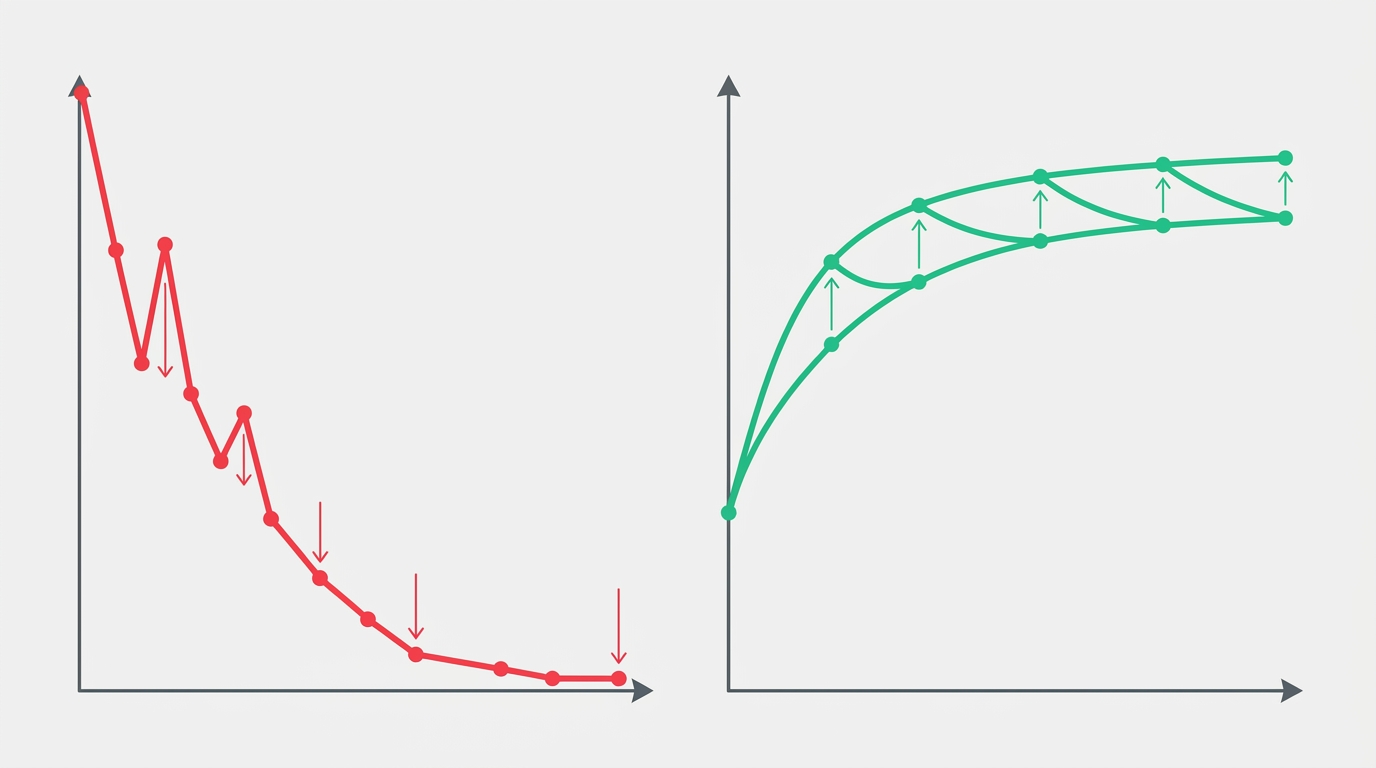
All-night cramming before tests might secure a passing mark the next morning, but over 70% of that information vanishes within days. Under high-stakes test pressure, fragile short-term memories frequently fail.
As demonstrated in landmark research published in Science (The Critical Importance of Retrieval for Learning), spaced retrieval practice consolidates knowledge into long-term neocortical networks. This creates durable memory traces that enable effortless recall on novel application questions.
Automatic Rescheduling and Burden Rebalancing on Missed Days

Missing a study session due to illness, fatigue, or busy schedules should never derail your preparation. In legacy flashcard apps, missed days cause hundreds of overdue cards to pile up, causing study abandonment.
PathMemoria's FSRS engine factors in missed days, recalculates memory decay rates, and redistributes overdue cards smoothly across upcoming sessions. This prevents backlogs and allows you to resume studying without stress.
Automated Weakness Detection and AI Diagnostic Support
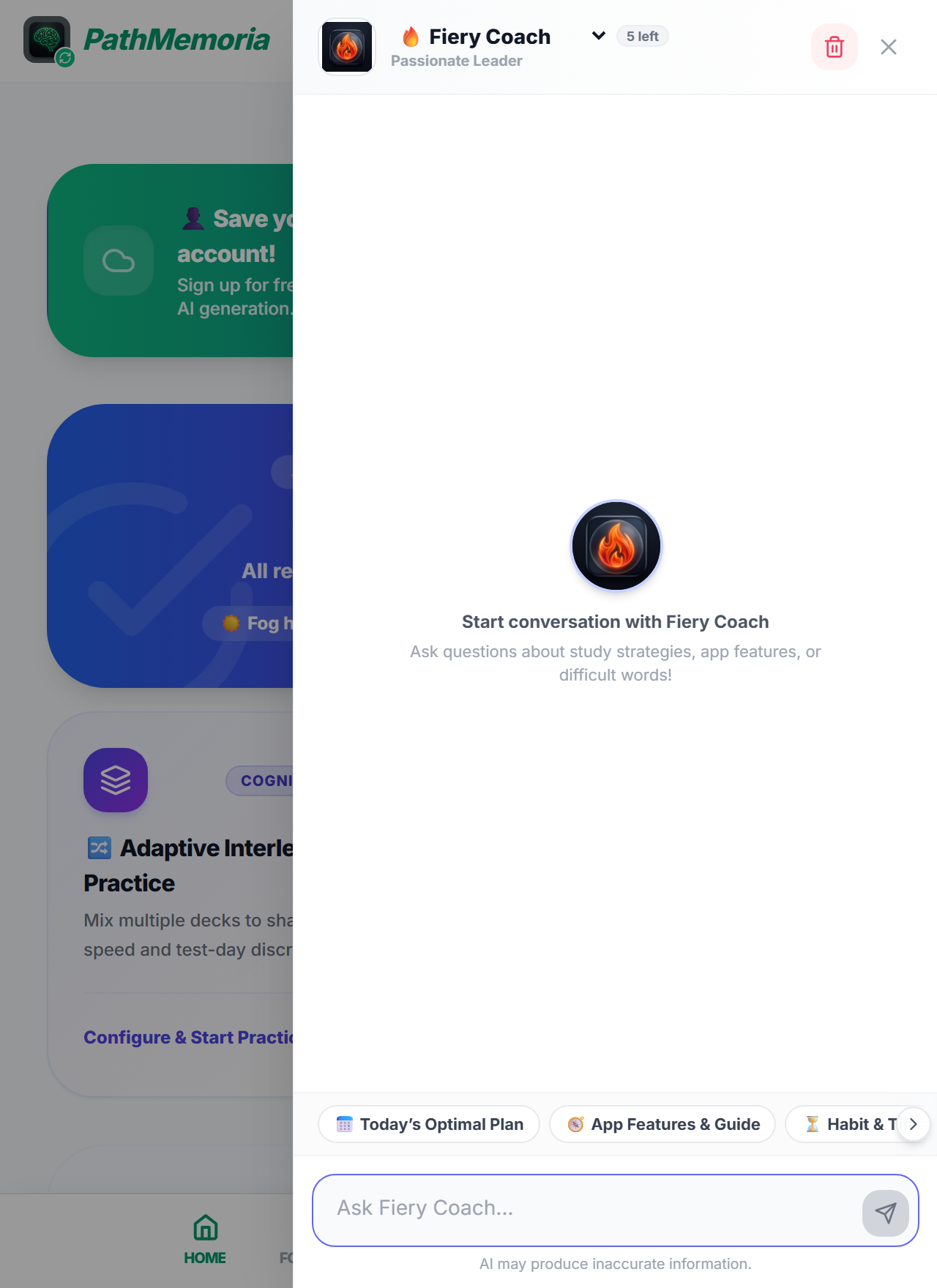
When mastering thousands of flashcards, a handful of difficult items inevitably cause repeated errors. PathMemoria automatically tags items with 3 or more failures (Lapses >= 3) as Weakness Cards.
These cards receive review priority and can generate instant AI explanations powered by Google's latest Gemini AI. With etymologies, mnemonics, and conceptual breakdowns available at a tap, you overcome stubborn weaknesses well before test day.
Visualize Progress with Retention Analytics and Mastery Charts
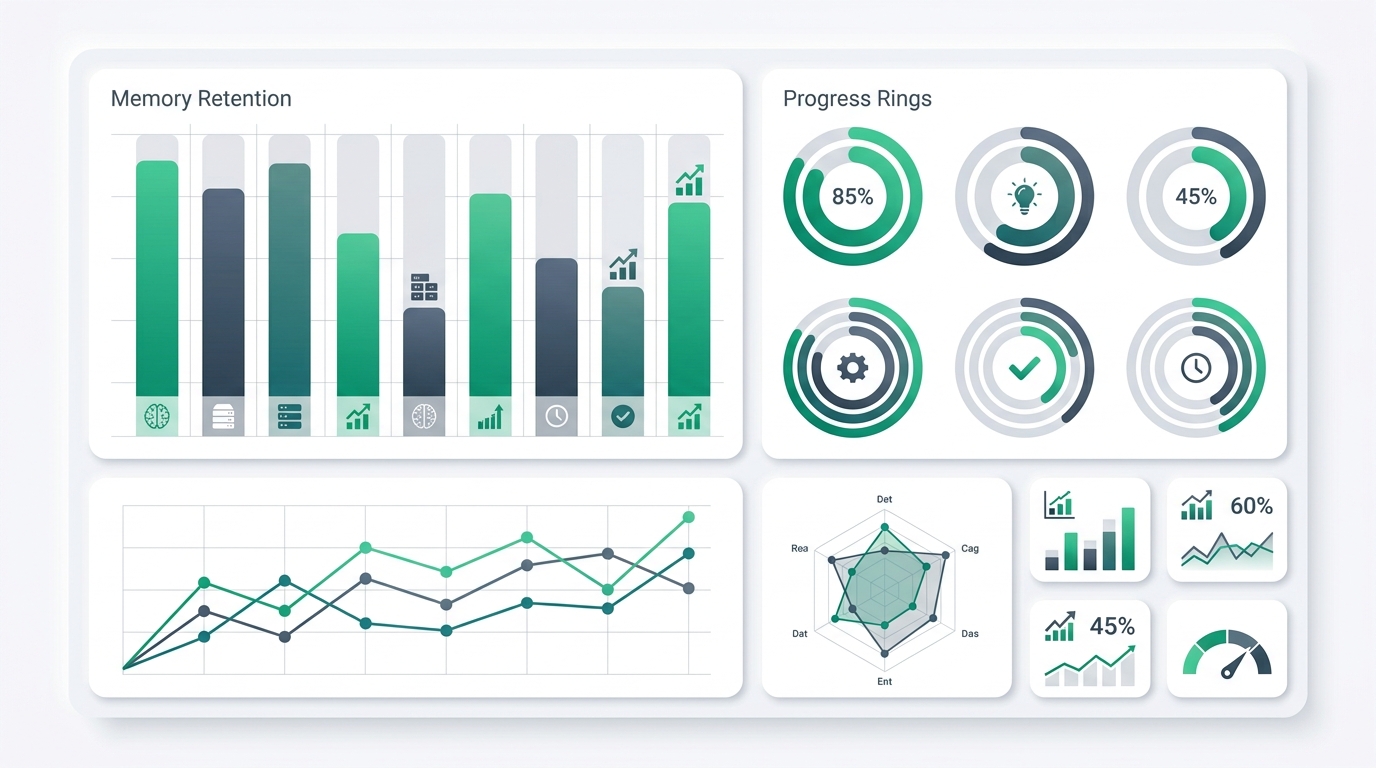
As highlighted in the NIH Behavioral & Habit Tracking Guidelines, tracking measurable progress is critical for sustained habit formation.
PathMemoria's analytics dashboard visualizes overall retention (e.g., 92.4%), total mastered cards, and average memory stability. Seeing empirical proof of your progress turns daily practice into an inspiring routine.
Gamify Daily Quotas with Streak Milestones and Level XP

Every time you clear your daily FSRS quota, your account gains XP and updates your consecutive study streak badge.
Reaching milestones like a 21-day streak provides powerful intrinsic motivation, making daily review a seamless and rewarding habit that fosters steady progress.
End willpower-driven studying. Pair FSRS v6 with exam countdowns to master your curriculum scientifically and reach your goals fast!
Conquer Spaced Repetition Reviews with a Scientific System

While there are no shortcuts in genuine learning, there is a definitive scientifically optimized path. End the cycle of inefficient reviews and leverage modern cognitive AI to reach your highest academic potential.
Open PathMemoria today, set your target exam date, and experience the transformative power of FSRS v6 spaced repetition!
📝 Review Quiz 2: Operational Optimization
Question: How does PathMemoria's FSRS system prevent study burnout when a learner misses a day due to illness or busy schedules?
💡 View Answer and Explanation
Answer: It automatically recalculates memory decay rates and redistributes overdue cards across future sessions in manageable daily quotas.
Explanation: Unlike static scheduling apps that create overwhelming backlogs, FSRS rebalances study volume dynamically to keep preparation on track.


![[2026 Guide] The Blurting Method: Skyrocket Memory Retention with Active Recall & AI](https://pathmemoria.tsmichi.com/blog/blurting_h3_tiktok_viral.jpg)