Hello everyone, I'm Taku, a high school educator and learning system developer.
"Every morning I make a firm promise: 'Tonight after work or school, I will study for two uninterrupted hours!' Yet the moment I collapse onto the sofa at home, I find myself endlessly doom-scrolling on my smartphone until midnight, overwhelmed by suffocating guilt and self-loathing..."
"I buy a brand-new certification textbook or vocabulary guide, study with intense fury for three days, but within a week it gathers dust on my desk—trapping me in an endless loop of starting and quitting..."
Mentoring hundreds of college entrance examinees and working professionals tackling demanding licensing exams, this is by far the single most common agony shared with me: "I lack the willpower to stay consistent, and I simply cannot turn studying into a daily habit." Diligent, ambitious learners inevitably conclude that they are fundamentally lazy, undisciplined, or weak-willed.
However, drawing from decades in the classroom and the objective evidence of cognitive neuroscience, let me state unequivocally: Your inability to study consistently has nothing to do with your character, grit, or innate willpower. It is caused entirely by buying into the fatal myth that 'studying requires motivation,' while using learning routines that directly violate how the human brain functions.
In the human brain, executive control and willpower are governed by the prefrontal cortex. This resource—known as willpower or ego depletion—is rapidly drained throughout the day by work tasks, social interactions, and thousands of micro-decisions. Demanding an exhausted evening brain to "power through with sheer grit" is like stomping on the gas pedal of a car with an empty fuel tank.
The only scientific way to build an unbreakable study habit is to remove motivation entirely from the equation and transfer behavioral execution to the brain's automatic autopilot system (the basal ganglia). The definitive tools to achieve this are "If-Then Planning," pioneered by NYU psychologist Dr. Peter Gollwitzer, and the "Tiny Habits" behavioral framework developed by Stanford University's Dr. BJ Fogg.
In this comprehensive masterclass guide, grounded in real-world teaching experience and cognitive science, we dissect why motivation fails, and introduce a battle-tested protocol to automate your study habits with If-Then triggers and micro-streaks—requiring zero willpower!
- •The Motivation Trap: Why relying on willpower causes prefrontal cortex ego depletion and guarantees habit relapse.
- •The Science of If-Then Planning: How Dr. Peter Gollwitzer's implementation intentions trigger automatic study actions without conscious effort.
- •The Tiny Habits Principle: Lowering initial friction to "just 1 flashcard" to activate work-induced dopamine and sustained momentum.
- •Micro-Streaks × FSRS Automation: Harnessing loss aversion and PathMemoria's smart daily queues to keep your streak alive effortlessly.
Why Relying on Motivation Guarantees Failure: The Neuroscience of Habit Relapse
"I can't get myself to study because I don't feel motivated." This single, pervasive belief is the root cause trapping millions of earnest students in endless cycles of procrastination and self-blame. Let us look inside the human brain to understand why motivation is the worst possible fuel for learning.
- 1. Prefrontal Ego Depletion: Daily decision fatigue drains willpower, turning opening a book into an insurmountable psychological hurdle.
- 2. Victim to Status Quo Bias: The brain's primal survival circuitry prioritizes effortless, familiar defaults (mindless phone checking) over effort.
- 3. Erosion of Self-Efficacy: Repeated cycles of quitting reinforce feelings of inadequacy, systematically destroying long-term confidence.
Prefrontal Cortex Ego Depletion: Every Decision Lowers Study Start Probability
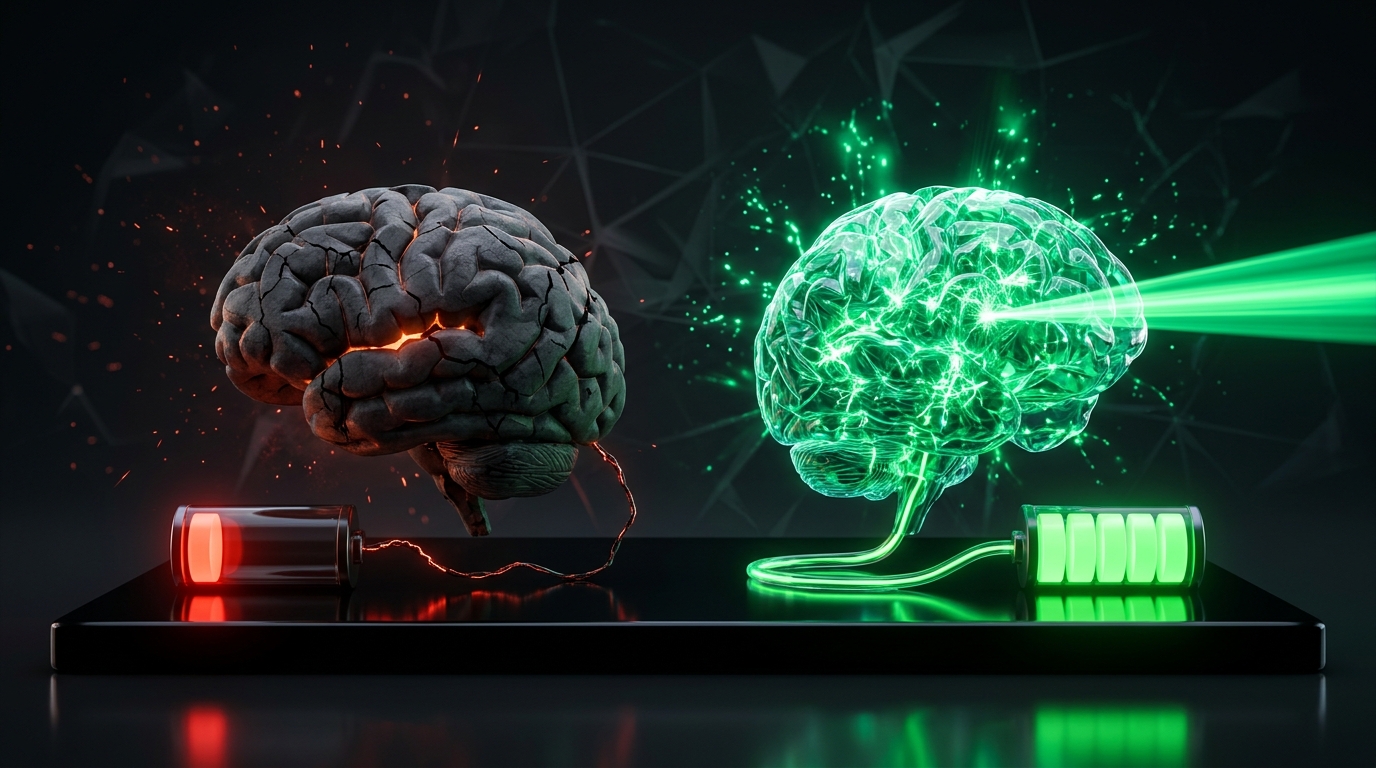
Willpower is not an abstract spiritual quality—it is a physical biological resource mediated by the prefrontal cortex of the brain. In groundbreaking research pioneered by Dr. Roy Baumeister (Baumeister et al., 1998), cognitive scientists demonstrated that conscious self-control draws upon a single, finite pool of mental energy, termed Ego Depletion.
Throughout an ordinary day, your brain makes thousands of decisions: replying to emails, navigating difficult conversations, resisting junk food, and prioritizing workplace tasks. By the time you return home at 7:00 PM, your prefrontal cortex's battery is virtually at zero percent.
If your study system requires you to sit down and consciously deliberate—"What subject should I study? Which page? Where is my pen? Should I study now or later?"—each decision acts as a massive friction barrier. An energy-starved brain will invariably choose the path of least resistance: sinking into the couch and scrolling short-form video feeds.
The 21-Day Myth vs. Reality: Lally's Research Proves Complex Habits Require 66+ Days
You have almost certainly heard the ubiquitous pop-psychology claim: "It takes 21 days to form a new habit." Self-help books and social media influencers repeat this figure endlessly. However, from an academic standpoint, this is a dangerous myth originating from a misinterpretation of cosmetic surgeon Maxwell Maltz's observations in the 1960s.
In rigorous empirical research published in the European Journal of Social Psychology, Dr. Phillippa Lally and her research team at University College London tracked 96 participants forming daily habits over 84 days.
The objective data revealed that the average time required to achieve peak automaticity (where an action happens effortlessly without conscious thought) was 66 days. Furthermore, while simple physical habits like "drinking a glass of water after breakfast" stabilized in roughly 18 days, complex, high-cognitive-load behaviors—such as studying technical materials or memorizing hundreds of foreign words—frequently required 80 to 254 days.
Believing in the "21-Day Myth" is psychologically catastrophic: when a learner reaches Day 22 and still feels resistance to studying, they conclude that something is wrong with them, giving up just as neural connections are beginning to take root. Understanding that building academic automaticity is a two-to-three-month rewiring process gives you the patience needed to stay the course.
Status Quo Bias: Why the Brain Chooses Passive Scrolling Over Effortful Study
Evolutionarily speaking, the human brain was never engineered for abstract academic examination prep, memorizing legal statutes, or analyzing financial balance sheets. For 99% of human evolutionary history, energy conservation was essential for survival in scarce environments.
As formulated in behavioral economics by William Samuelson and Richard Zeckhauser (Samuelson & Zeckhauser, 1988), human decision-making is dominated by Status Quo Bias—an innate cognitive heuristic to maintain current physical and mental states unless compelled by overwhelming environmental cues.
When you arrive home and sit down, your status quo is "resting." Shifting from resting to high-effort analytical study requires an enormous surge of kinetic mental energy. Smartphones exploit this vulnerability masterfully: offering variable dopamine rewards with zero physical friction. Overcoming status quo bias requires external, concrete triggers that bypass deliberation altogether.
The Fallacy of "I'll Study When I Feel Like It": Action Triggers Dopamine, Not Vice Versa
"I'll wait until inspiration strikes and I feel like studying." If you operate by this principle, you will spend most of your life waiting. Modern neuroscience has revealed a profound truth: Emotion does not precede action; physical action precedes neural motivation.
Deep within the human brain lies the nucleus accumbens, a critical node in the dopaminergic reward pathway. Research in neurobiology demonstrates that the nucleus accumbens remains dormant while you are passively sitting and wishing for motivation. It only begins releasing dopamine and generating focus once your sensory organs and motor cortex engage in an activity for several minutes—a phenomenon psychologists refer to as "work-induced excitement" (work excitement).
Action is the catalyst that lights the fire of motivation. The entire secret to consistent daily learning is designing a mechanism that initiates that first 60 seconds of physical action with virtually zero resistance.
The Scientific Habit Engine: If-Then Planning × Micro-Streak Protocol
Now that we have dismantled the motivation myth, let us explore the concrete, scientific architecture that turns studying into an automated, daily reflex as natural as brushing your teeth.
1. If-Then Planning
Pairing exact environmental cues with micro-actions to program neural reflexes into the basal ganglia.
2. Tiny Habits Threshold
Shrinking the opening action to "answer just 1 flashcard" to eliminate cognitive activation friction.
3. Micro-Streak Loss Aversion
Leveraging visual streak counters so the psychological pain of breaking the chain fuels consistency.
4. FSRS AI Queue Delivery
Automating daily card selection so learners never waste a single drop of willpower deciding what to review.
Peter Gollwitzer's If-Then Planning: Automating Triggers to Triple Execution Rates
The single most rigorously verified self-regulation strategy in psychology is Implementation Intentions, commonly known as If-Then Planning, formulated by Dr. Peter M. Gollwitzer at New York University (Gollwitzer, 1999).
Traditional goal-setting sounds like this: "I will study hard every day" or "I will pass the exam in November." Gollwitzer demonstrated that such vague goal intentions produce dismal follow-through rates. In contrast, an Implementation Intention specifies the precise environmental contingency:
THEN [ I will immediately perform specific behavior Y without hesitation ].
In a meta-analysis encompassing 94 independent studies with over 8,000 participants (Gollwitzer & Sheeran, 2006), If-Then planning produced a massive medium-to-large effect size of d = 0.65 on goal attainment—more than doubling or tripling real-world execution rates.
Neurologically, creating an If-Then plan pre-activates the sensory representation of the situation in memory. When cue X occurs, the perceptual system detects it instantaneously, triggering action Y below the threshold of conscious deliberation. Control shifts from the easily fatigued prefrontal cortex to the basal ganglia—the brain's automatic habit engine.
The Living-Routine Trigger Directory: Anchoring Study to Coffee, Commutes, and Waking Up
The biggest mistake beginners make with If-Then planning is using time-based triggers (e.g., "If it is 8:00 PM, I will study"). Clocks are abstract and easily ignored when you are caught up in work or chores.
The gold standard is to anchor your study to an unshakable, already established daily bodily anchor. Here is a curated trigger directory battle-tested by high-scoring students and professionals:
| Target Scenario | [IF] Everyday Physical Trigger | [THEN] Immediate Micro-Action | Neurological Mechanism |
|---|---|---|---|
| Morning Wake-up | The moment my feet touch the floor after turning off my alarm | Open PathMemoria and answer exactly 3 review cards | Clears sleep inertia by directing prefrontal cerebral blood flow |
| Morning Commute | The instant the train doors close and the train starts moving | Put on wireless earbuds and press Voice Autoplay | Transforms idle transit into effortless hands-free audio retrieval |
| Coffee Break | While waiting for coffee to brew or cup to fill (60 seconds) | Review 5 quick vocabulary or formula cards on mobile | Piggybacks on existing dopamine anticipation from caffeine |
| Returning Home | Immediately upon taking off my shoes in the entryway (before sofa!) | Place bag on desk and open the textbook to page 1 | Interrupts couch status quo bias before inertia takes hold |
| Bedtime Wind-down | As soon as my head rests on my pillow and lights are dimmed | Review the 5 hardest cards of the day for 2 minutes | Primes slow-wave sleep memory consolidation in the hippocampus |
BJ Fogg's Tiny Habits Model: Shrinking Friction to "Just One Flashcard"

Even with a pristine If-Then trigger, you will fail if the planned action is too intimidating. If your rule is: "When I sit at my desk, I will solve 5 complex math problems," an exhausted brain will rebel.
This is where Dr. BJ Fogg's Tiny Habits Model becomes indispensable (Fogg, 2009). Fogg established that human behavior ($B$) is governed by three concurrent elements:
When motivation ($M$) is low (as it is after a draining day of work or classes), an action can only succeed if Ability ($A$) is made extraordinarily simple. If an action requires virtually zero physical or cognitive effort, it lands above the "Action Line" and occurs reliably.
Set your initial commitment so ridiculously small that it is impossible to say no:
- ❌ Fatal Rule: "I will study certification cards for 45 minutes every evening."
- ✅ Tiny Habit Rule: "I will open PathMemoria and tap through exactly 1 card."
Once you solve that single card, the psychological resistance evaporates. The nucleus accumbens detects engagement and secretes dopamine. In 90% of cases, you will naturally think, "Well, I'm already here—might as well finish 5 more." But even if you stop after card #1, the neurological habit loop has fired and strengthened.
📝 [Check Quiz 1] Let's Test Your Habit Formation Knowledge!
[Question] According to Dr. Phillippa Lally's empirical habit research, what is the average number of days required for a complex cognitive habit to reach peak automaticity?
💡 Reveal Correct Answer & Explanation
[Correct Answer] Approximately 66 days (with complex academic habits ranging from 80 to 254 days).
[Explanation] The popular "21 days" figure is an unsubstantiated myth. Expecting habit automaticity within 3 weeks leads to premature quitting; true neural rewiring requires 2 to 3 months of consistent environmental trigger pairing.
The Micro-Streak Psychological Shield: Loss Aversion Keeps the Chain Unbroken

Once your habit begins rolling, how do you sustain it through weeks and months of inevitable busy spells and low-energy days? The psychological answer is Micro-Streaks.
In Nobel Prize-winning research on Prospect Theory (Kahneman & Tversky, 1979), psychologists demonstrated Loss Aversion: the psychological pain of losing something is roughly 2.0 to 2.5 times more intense than the joy of an equivalent gain.
When you maintain an unbroken study streak visible on your app dashboard—"🔥 14 Consecutive Days"—your brain internalizes that streak as a prized psychological possession. When temptation strikes to skip studying, loss aversion activates: "If I skip tonight, my 14-day streak resets to zero." The pain of losing the streak overrides the lethargy of sitting on the couch, propelling you to open the app and review your cards.
PathMemoria × FSRS Automation: Zero-Willpower Daily Quota Queues
The fatal flaw of traditional studying is the overwhelming cognitive friction of schedule management. Opening a binder and wondering, "Which chapters should I review? Did I review civil law yesterday? When should I re-test these 200 vocabulary words?" consumes precious prefrontal willpower before you even answer a single question.
PathMemoria eliminates this decision fatigue entirely with its native FSRS v6 (Free Spaced Repetition Scheduler) engine.
Whenever you log into the web or mobile PWA, PathMemoria analyzes your historical retention data and automatically places today's exact review queue in front of you. There are zero folders to sort, zero calendar dates to track, and zero decisions to make. You simply tap through the cards served to you. Combining this with the app's Target Date Back-Calculation ensures you hit 90%+ exam-day retention while keeping daily cognitive friction at absolute zero.
Overcoming Burnout & Slumps: The 2-Day Rule to Prevent Relapse Spirals
Life happens: an unexpected sickness, overtime work, or personal emergencies will eventually disrupt your schedule. When perfectionists miss a single day, they fall into the "What-the-Hell Effect" (counter-regulatory eating / habit relapse), believing everything is ruined and quitting permanently.
To inoculate yourself against relapse, adopt James Clear's golden "Never Miss Twice" Rule (The 2-Day Rule):
🛡️ The 2-Day Fallback Protocol
Missing one day due to unavoidable circumstances is an accident; missing two consecutive days is the start of a new, destructive habit of skipping.
If an emergency forces you to skip Monday, Tuesday's single absolute priority is to complete a Tiny Habit session (just 1 card or 60 seconds). Even if your study time drops by 90%, completing that single action protects your neural identity as a consistent learner and halts the downward relapse spiral.
📝 [Check Quiz 2] The Psychology of Streaks and Habit Recovery
[Question] What cognitive bias explains why visual streak counters (e.g., "14-Day Consecutive Study Streak") are so profoundly effective at preventing study lapses?
💡 Reveal Correct Answer & Explanation
[Correct Answer] Loss Aversion (Prospect Theory by Kahneman & Tversky).
[Explanation] Humans feel the pain of losing an existing asset (such as an accumulated streak) roughly twice as acutely as an equivalent gain. The psychological pain of resetting the streak back to zero provides an instant counter-weight to momentary laziness.
Summary: Design Systems, Not Motivation, to Master Lifelong Learning
Let us bring together the foundational insights of behavioral science and educational coaching:
Consistency is not a genetic gift reserved for a disciplined few. It is the natural outcome of a well-engineered cognitive environment. By removing motivation from the driver's seat and installing automated triggers, you can conquer any certification, master foreign languages, and achieve academic excellence with ease.