![[Complete Tutorial] How to Auto-Generate Flashcards & Batch AI Explanations with Google's latest Gemini AI](https://pathmemoria.tsmichi.com/blog/ai_gen_hero_eyecatch.jpg)
Hello! I'm Taku. In my daily teaching experience mentoring high school students for competitive college admissions and professional certifications, I frequently hear: "My syllabus is so vast that by the time I finish writing flashcards and organizing summary notes, the exam is tomorrow," and "Manual card preparation is so exhausting that I never have enough time left for active testing." Adult professionals face the exact same bottleneck when dealing with dense licensing manuals.
In the past, spending hours neatly handwriting colorful review notes was considered a badge of honor. However, modern cognitive science has demonstrated that passive transcription contributes virtually nothing toward long-term neural memory consolidation.
As emphasized by the U.S. Department of Education Digital Learning Framework, leveraging AI and digital tools to streamline self-study is the most effective modern learning protocol. In 2026, the ultimate study strategy is simple: "Snap a photo of your textbook page with your smartphone, let multimodal AI auto-generate active recall questions, and review automatically." In this guide, I will share the exact science and step-by-step workflow to generate high-yield AI flashcards in one second.
- •How smartphone camera AI converts printed textbook pages into active flashcards in 1 second.
- •How NLP algorithms automatically identify high-yield exam concepts and definitions.
- •How to enforce the Atomic 1-Fact Principle to maximize memory retrieval speed.
- •Step-by-step tutorial on using Google\'s latest Gemini AI in PathMemoria to cut study prep time to zero.
3 Major Benefits of Auto-Generating Flashcards from Textbook Photos with AI
The primary breakthrough of AI flashcard generation is eliminating 100% of the manual preparation overhead, allowing you to invest every second of your study time into active retrieval testing. Let's examine the three core advantages of this technology.
No More Manual Typing! Convert Photos to Flashcards in 1 Second

With traditional study methods, creating flashcards required tedious card-by-card typing on a mobile screen. Compiling a modest 100-card deck could consume several exhausting hours, leaving learners mentally drained before active practice even began.
Modern multimodal AI transforms this workflow completely. Simply point your smartphone camera at a textbook chapter or lecture printout. Advanced optical character recognition (OCR) instantly parses printed and handwritten text, while generative AI formats the content into clean "Front: Question" and "Back: Answer & Context" flashcards within one second.
How AI Automatically Extracts Key Concepts from Textbook Text

Simply pasting raw paragraphs onto cards creates text-heavy clutter that is impossible to review efficiently. The true intelligence of modern generative AI lies in its ability to extract the underlying pedagogical core (definitions, causal chains, and comparative distinctions) and transform them into precise test prompts.
Trained on extensive academic datasets and testing methodologies, the AI identifies what examiners typically test—such as key historical actors, biological mechanisms, or legal elements. You receive professionally crafted active recall questions from a single photo, elevating your study materials to the level of top-tier tutoring.
Divide and Conquer! Enforce Atomic 1-Fact Principle with AI

When humans create study cards manually, they frequently make the mistake of cramming multiple facts onto a single card. Multi-fact cards increase cognitive fatigue, slow down recall speed, and make self-assessment ambiguous when only part of the answer is remembered.
The foundational rule of cognitive memorization is the "Atomic Principle" (One Fact per Card). PathMemoria's AI prompts strictly enforce this rule, automatically deconstructing complex textbook paragraphs into separate, focused single-fact cards. This structure enables rapid 2-second recall drills and smooth study flow.
High-Precision OCR Technology for Science Diagrams and Graphs

Modern Vision AI extends far beyond plain text recognition. Biological diagrams of cardiac structures, anatomical systems, historical battle maps, and physics graphs can all be analyzed and converted into interactive study prompts.
The AI understands visual relationships—such as the specific physiological function indicated by an arrow or the inflection point of a mathematical curve. Combining visual diagrams with focused textual questions engages both the visual cortex and the temporal lobe, creating far more resilient memory traces than text alone.
Language, History, Science, and Law: Subject-Specific AI Examples

PathMemoria's AI adapts its output format dynamically to match the requirements of each subject. Here is how textbook photos are formatted across disciplines:
| Subject / Exam | Scanned Material | [Front]AI Generated Prompt | [Back]AI Generated Answer & Explanation |
|---|---|---|---|
| Foreign Languages | Reading comprehension article | vulnerable (contextual definition) | [Definition]susceptible to physical or emotional harm [Etymology]vulnus (wound) + able |
| History & Civics | Historical treaty textbook page | What were the 2 primary unequal clauses in the 1858 Treaty of Amity and Commerce? | 1. Recognition of extraterritoriality (consular jurisdiction) 2. Denial of tariff autonomy |
| Chemistry & Science | Chemical reaction study guide | What is the primary product synthesized via the Solvay ammonia-soda process? | Sodium carbonate (Na2CO3) ※ Byproduct: Calcium chloride (CaCl2) |
| Law & Bar Exams | Real estate law exam prep book | Is a contract for the sale of property owned by a third party legally valid? | Valid (Civil Code Art. 561). The seller incurs an obligation to acquire and transfer the title. |
Simply photographing your study material yields a customized, high-yield active recall deck in seconds.
📝 [Knowledge Check 1]Test Your Understanding!
[Question] What is the cognitive science principle that dictates flashcards should focus on only one specific fact per card?
💡 Reveal Answer & Explanation
[Correct Answer] The Atomic Principle (One Fact per Card)
[Explanation] Splitting study items into single-fact prompts optimizes mental retrieval effort, removes ambiguity during grading, and maximizes spaced repetition efficiency.
Powered by Gemini! Step-by-Step AI Flashcard Creation in PathMemoria
The latest edition of PathMemoria integrates Google's cutting-edge Google's latest Gemini Flash AI model directly into its web and mobile interface. Here is the step-by-step protocol to create and master your decks.
3-Step Workflow: Snap a Photo and Build a Deck in 1 Second
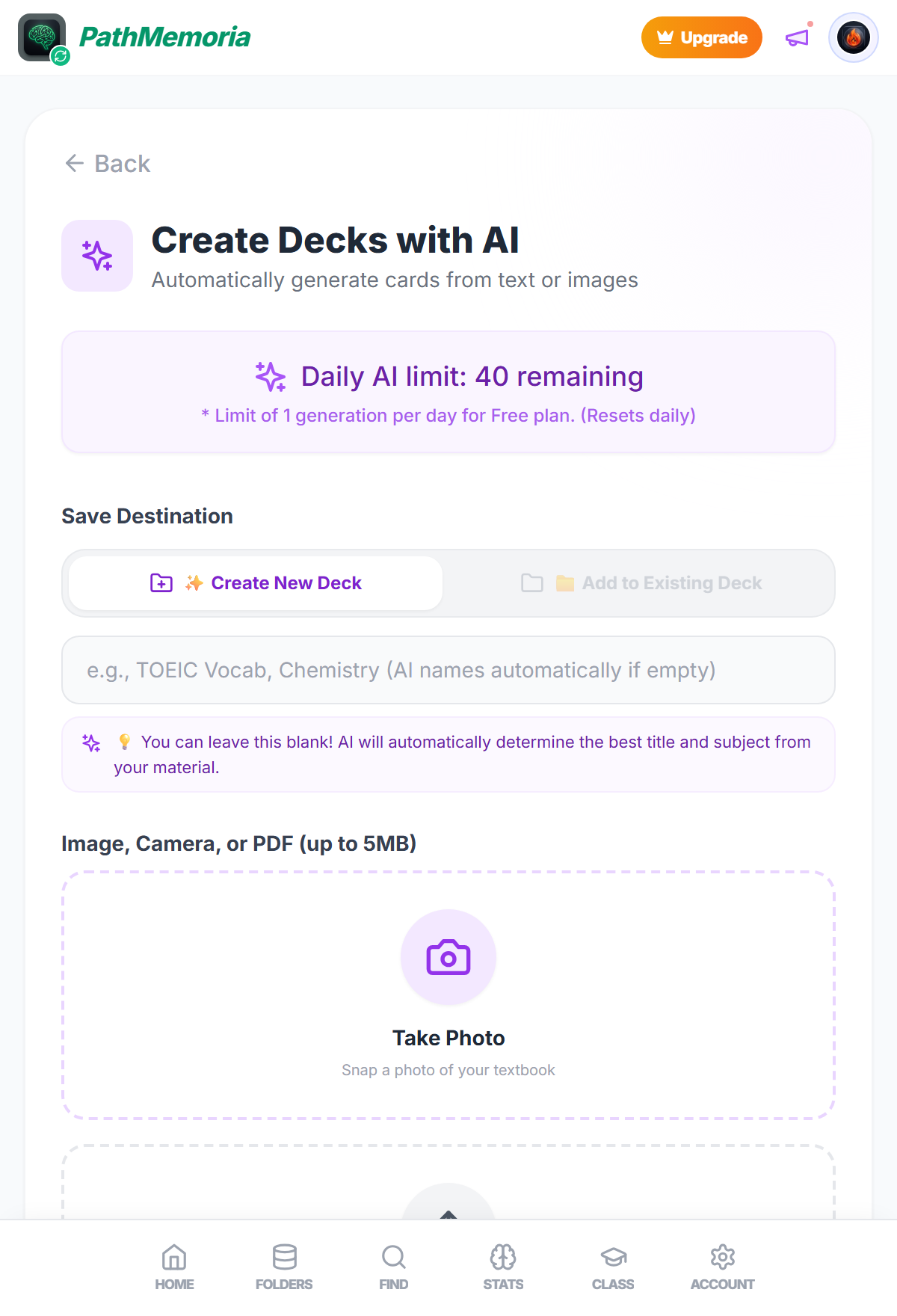
Creating flashcards in PathMemoria is remarkably straightforward. Open the app, tap "AI Camera Generation," and snap a photo of any textbook page or printed handout.
The AI processes the image within seconds, generating 10 to 20 formatted active recall cards. Preview the cards, make any optional edits, and tap "Save Deck" to start testing immediately. You can also append custom instructions such as "Focus on difficult terms" or "Explain for high school level."
AI Tutor: Instant Deep Explanations for Mistakes During Quizzes
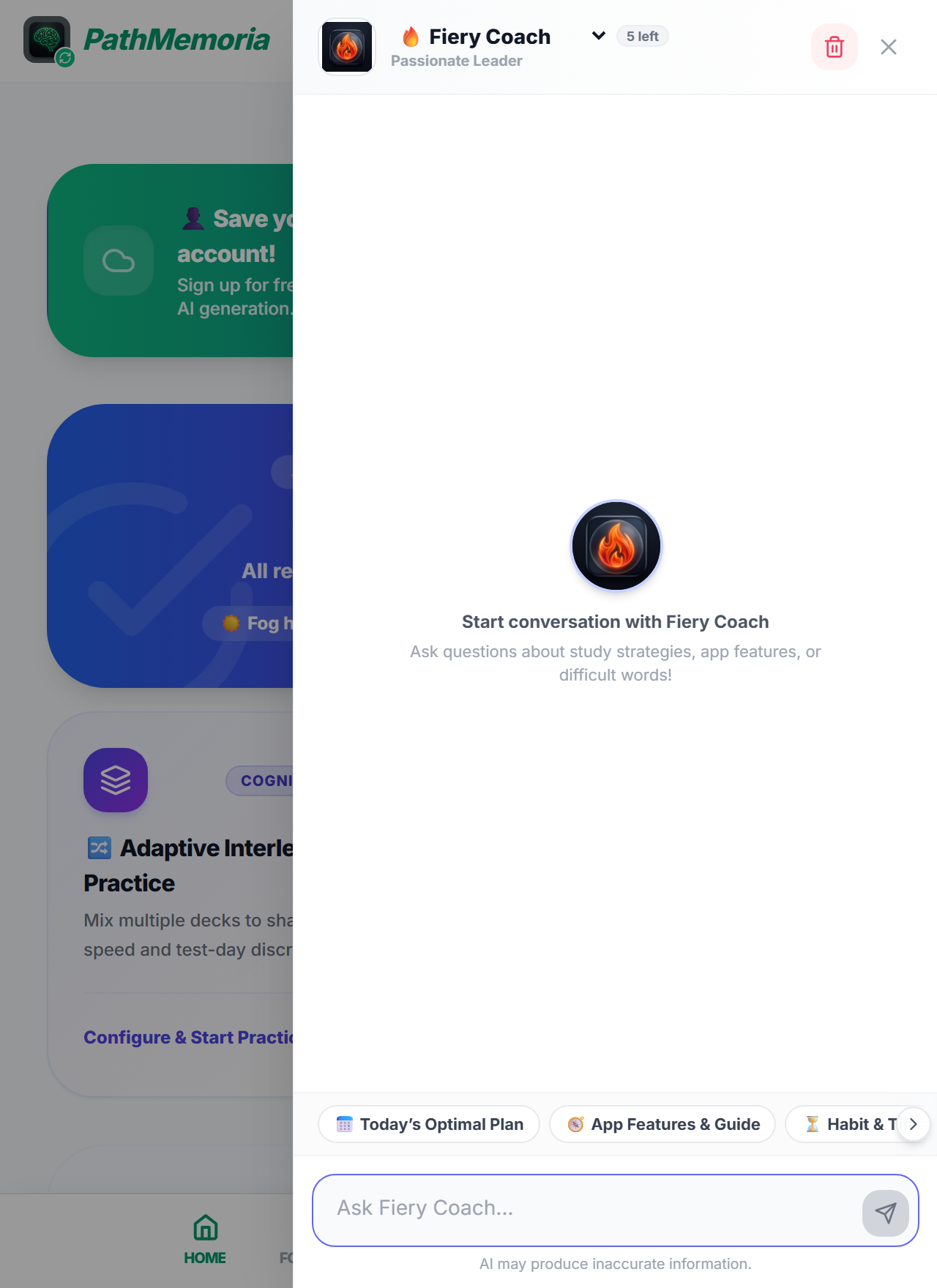
The biggest time drain during review sessions is pausing to search through bulky reference books whenever you get an answer wrong. PathMemoria MAX plan resolves this with Batch AI Deep Explanations.
Whenever you fail to recall a card, simply tap "Explain with AI". Google's latest Gemini Flash AI instantly breaks down the background context, offers memorable mnemonics, and clarifies distinctions from easily confused concepts. Having a dedicated 24/7 AI tutor turns every mistake into an immediate learning victory.
Automate Review Intervals for AI Decks with FSRS Spaced Repetition
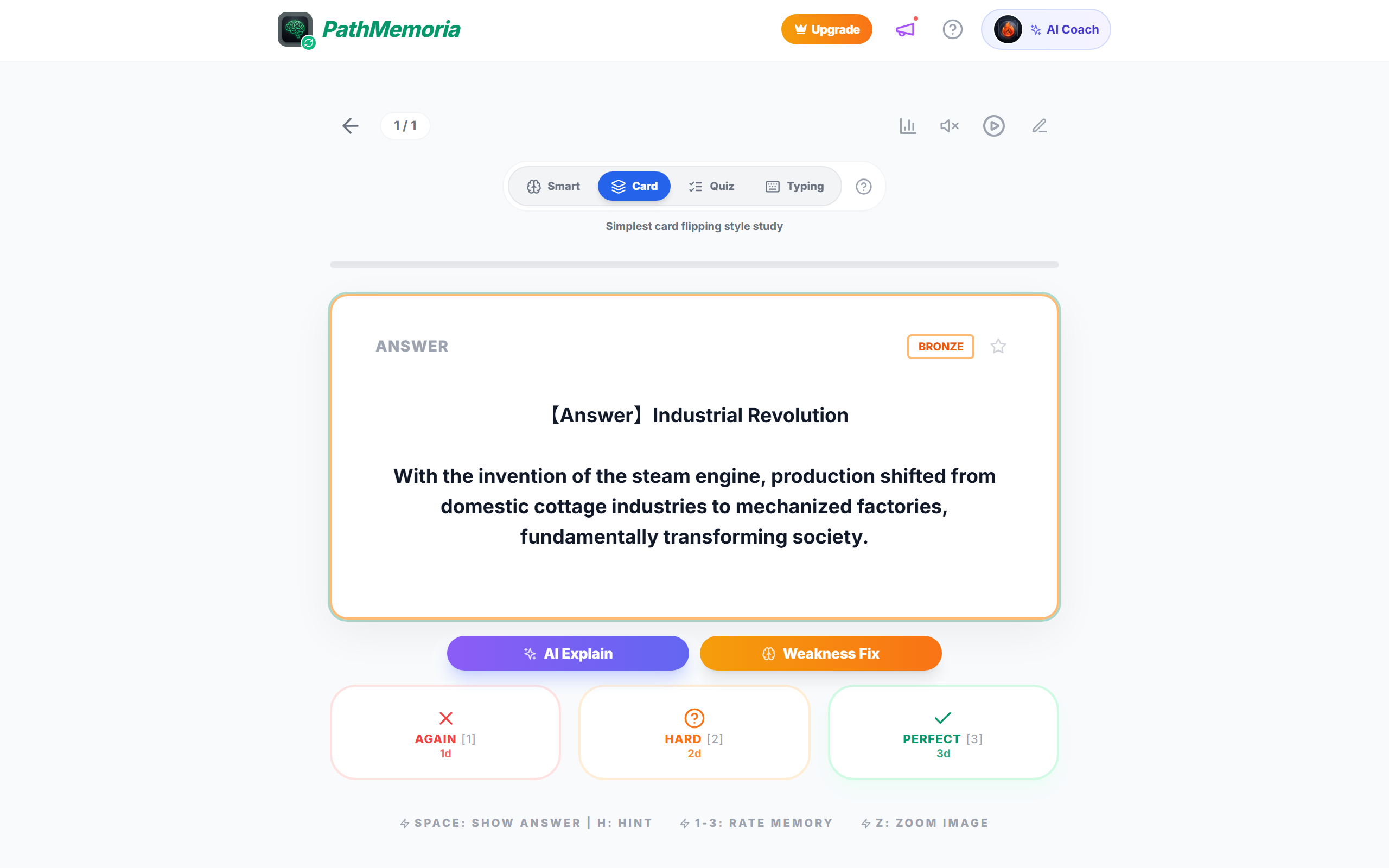
Even the best study cards lose their power if reviewed at the wrong intervals.
As validated by landmark cognitive research in Science (Karpicke & Roediger, 2008), long-term retention requires active retrieval testing scheduled right as memories begin to decay. PathMemoria seamlessly connects AI-generated decks to its modern FSRS v6 algorithm, automatically calculating optimal review intervals at 1 day, 3 days, 1 week, and 1 month.
Hands-Free Voice Autoplay: Review Decks During Morning Commute
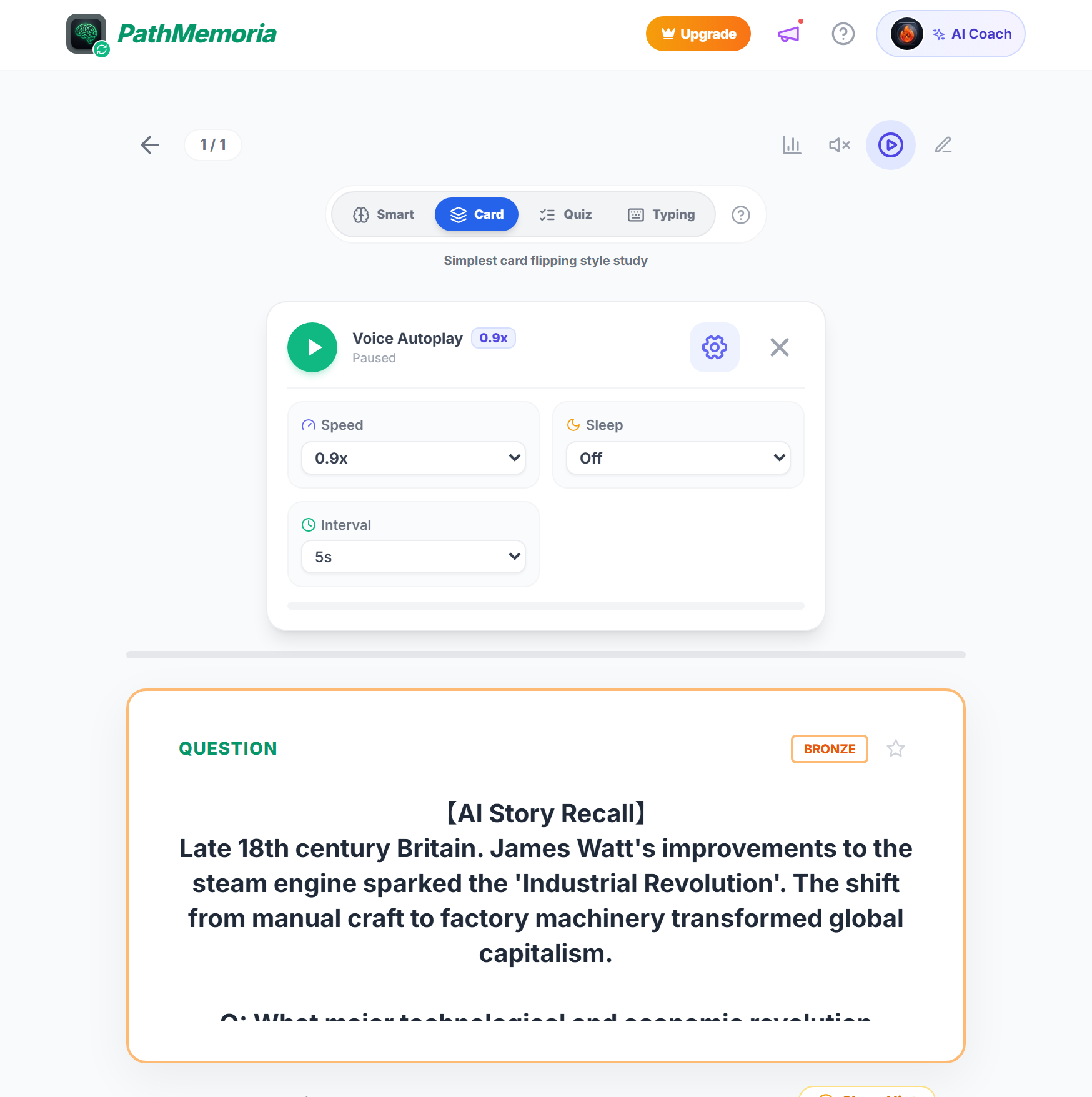
For busy students and working professionals, commute time is the most valuable study window. Supported by healthy lifestyle guidelines from the National Institutes of Health (NIH), maintaining consistent micro-study habits without sacrificing sleep is the key to sustainable performance.
PathMemoria's "Voice Autoplay" mode reads the question aloud, pauses for 2.5 seconds to allow mental recall, and speaks the answer. Even on crowded trains where you cannot hold your phone, you can complete hundreds of active retrieval trials hands-free.
📝 [Knowledge Check 2]AI Study Strategy Check!
[Question] What is the most effective workflow when creating AI flashcards from textbook photos?
💡 Reveal Answer & Explanation
[Correct Answer] Using AI to auto-generate atomic 1-fact cards instantly, and reviewing them via FSRS spaced repetition algorithms right before forgetting.
[Explanation] Offloading card preparation to AI frees up 100% of your energy for active retrieval testing at scientifically optimized intervals.
Summary: Eliminate Prep Overhead with AI and Dominate Exams!

Modern study success is not determined by how many hours you spend handwriting notes—it is determined by how quickly you turn notes into active questions and how frequently you test your memory.
Photographing your study materials transforms your smartphone into the world's most powerful AI study companion. Ditch manual writing fatigue today and experience zero-prep memorization with PathMemoria AI Camera Scan!

![[2026 Guide] The Blurting Method: Skyrocket Memory Retention with Active Recall & AI](https://pathmemoria.tsmichi.com/blog/blurting_h3_tiktok_viral.jpg)