![[2026 Guide] Subject-Specific & Last-Minute Memorization Protocols for Exam Success](https://pathmemoria.tsmichi.com/blog/memorization_hero_2026.jpg)
Hello, I'm Taku. With an upcoming exam just a week away, have you ever felt overwhelmed thinking, "I can't possibly memorize all these history dates and science terms" or "I memorized math formulas and vocabulary, but my mind goes completely blank during exams"? Working closely with high school students every day, I have learned that the difference between top performers and struggling students is never natural memory talent. It comes down entirely to knowing subject-specific, evidence-based memorization strategies.
Moving beyond passive textbook reading, this comprehensive guide reveals specialized memorization protocols tailored for STEM, humanities, and languages, alongside emergency cramming strategies to maximize test scores within 72 hours. By adopting scientific methodologies aligned with the U.S. Department of Education Curriculum & Learning Guidelines, you can achieve your personal best with minimal wasted effort!
- •Subject-specific memorization protocols for humanities, STEM, and languages
- •Emergency 3-day memorization techniques to maximize test scores
- •How to memorize historical causality and math formulas as stories
- •Rapid roadmap using AI spaced repetition and exam countdown scheduling
Subject-Specific Memorization Protocols to Boost Retention
While language vocabulary often gets the most attention, the human brain processes historical narratives, scientific concepts, and mathematical problem-solving through fundamentally different cognitive mechanisms. Here are specialized memorization protocols optimized for each discipline.
Master History Through Causality Rather Than Raw Dates

Rote memorization of isolated years, names, and treaties in history is notoriously inefficient. Abstract dates lack emotional anchors in episodic memory, leaving students helpless when faced with chronological ordering or essay-style explanation questions. Cognitive psychology shows that human memory consolidates most securely when facts are connected through meaningful, causal narratives.
When learning historical topics, always structure concepts into a three-step chain: Cause (why it occurred) -> Progression (who acted and how) -> Consequence (how it shaped subsequent eras). For instance, rather than memorizing a treaty date alone, note the economic crisis that sparked conflict, the diplomatic goals, and the eventual political shifts. Once this narrative framework is in place, active recall flashcards lock in the precise terminology, ensuring flawless performance on complex multi-choice exams.
Memorizing isolated years won't help on chronological exam questions. Anchor each event with causal connectors like 'because of previous famine' to build real historical mastery!
Memorize the First Step of Solutions in Math and Science

Many students believe math and physics require purely conceptual thinking and zero memorization. In reality, the fastest way to raise STEM test scores on standard exam problems is "solution pattern memorization." However, copying entire multi-line derivations into notebooks is a waste of time. The critical skill is retrieving the "first step" (which formula applies and how to set up line one of the solution) within three seconds of reading problem conditions.
When reviewing problem sets, read the prompt and immediately visualize or jot down the opening equation in three seconds. Once line one is correctly formulated, subsequent steps are routine arithmetic and algebra. Rapidly cycling through three problem prompts per minute trains instantaneous pattern recognition, allowing you to react immediately to standard problems during high-pressure exams.
Learn Languages Through Collocations and Example Sentences

When learning English or foreign vocabulary, relying exclusively on 1-to-1 word-to-definition pairs leaves critical gaps. Isolated words fail in reading comprehension and essay writing because learners cannot determine appropriate prepositions or nuances. The key to authentic mastery is memorizing words within natural collocations and short phrase chunks.
For example, instead of learning "depend" in isolation, memorize the chunk "depend on" along with a short 5-to-7-word sentence read aloud repeatedly. Engaging visual text, vocal articulation, and auditory feedback simultaneously activates multiple language cortex regions, forging durable neural pathways. This vocal habituation allows correct preposition choices to feel natural and intuitive during grammar tests.
Solidify Vocabulary and Terms with Air-Writing Quizzes
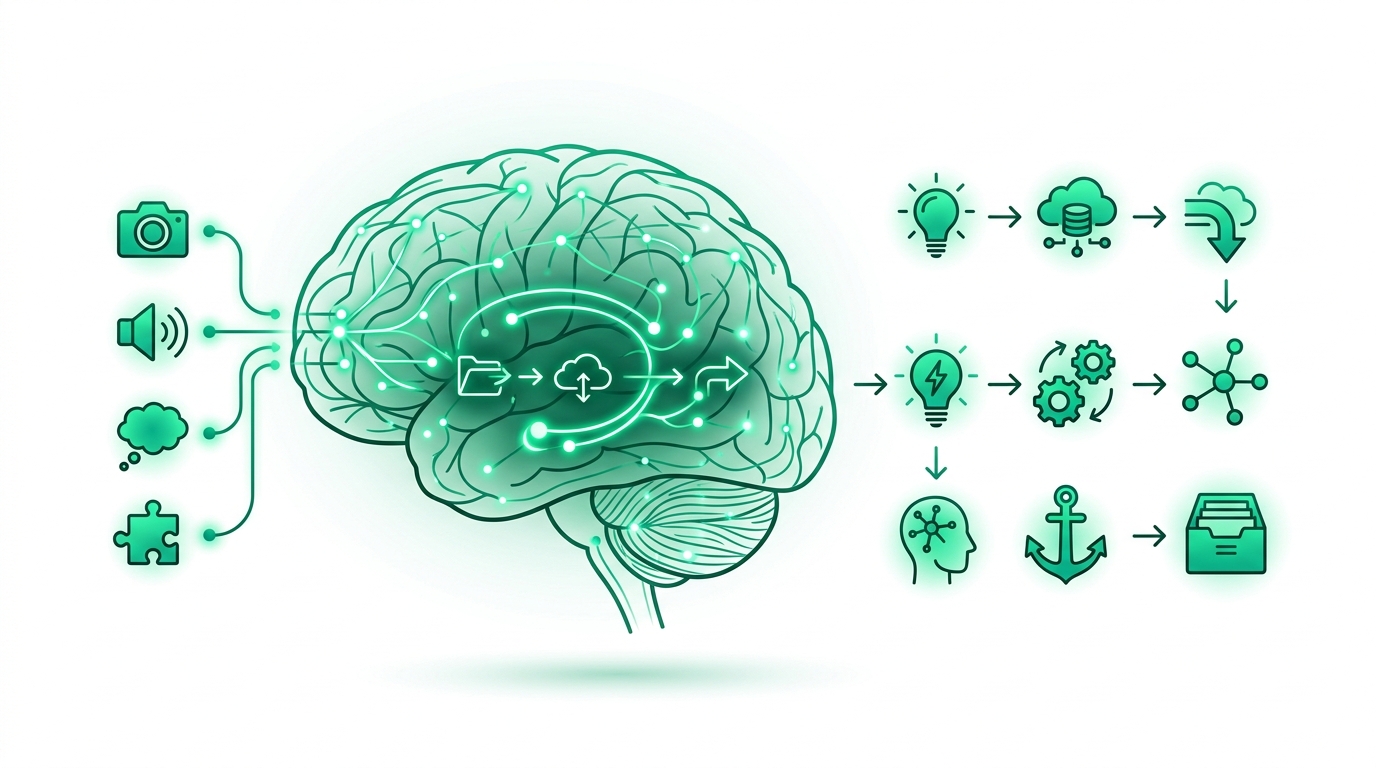
Passive reading creates a powerful illusion of competence. When facing blank test sheets, students frequently lose points to minor spelling or character mistakes because visual familiarity does not equal retrieval precision. Scientific terminology and complex characters require active motor engagement.
Applying the active retrieval principles proven in Science by Dr. Jeffrey Karpicke (The Critical Importance of Retrieval for Learning), integrate fingertip "air-writing" into flashcard sessions. Cover the answer and trace the spelling or chemical formula with your finger on a desk before checking. This motor-sensory loop engages both the motor cortex and hippocampus, eliminating careless spelling errors without requiring messy notebooks.
Contrast Confusing Concepts in Pairs for Multiple-Choice Exams

The primary pitfall in standardized multiple-choice exams is deceptive distractor options. When studying biology enzymes, economic systems, or political terminology independently, students often struggle to identify exact differentiating criteria under time pressure.
To neutralize exam traps, memorize easily confused concepts in explicit contrast pairs. Create flashcards asking "What is the key difference between Term A and Term B?" Pairing similarities and distinctive differences equips your working memory to eliminate false distractors instantaneously.
📝 Review Quiz 1: Subject-Specific Memorization Takeaways
Question: In STEM subjects like math and physics, what should you focus on actively recalling during rapid flashcard reviews instead of recalculating full multi-step solutions?
💡 View Answer and Explanation
Answer: The "first step" of the solution: identifying which formula applies and setting up line one of the equation.
Explanation: Once line one is correctly formulated, subsequent steps are routine arithmetic. Rapidly testing first-step recognition across dozens of problem prompts builds quick reflexes for exam day.
Last-Minute Emergency Memorization Hacks for Fast Gains
When facing an exam in three days with vast material remaining, panic is counterproductive. Here is the evidence-based emergency protocol to salvage maximum points in minimal time.
Drop Mastered Cards to Dedicate 100% to Unlearned Topics

The most common last-minute mistake is repeatedly reviewing familiar, comfortable questions for artificial reassurance. Re-solving questions you already know yields zero additional points on exam day. In the final 72 hours, the only valuable activity is isolating unlearned gaps and making them retrievable.
Begin by rapidly sorting test questions with 1-second assessments. Immediately check off and eliminate items you recall effortlessly. Dedicate 100% of your remaining study time exclusively to the uncertain 20%, generating rapid score jumps in the shortest possible timeframe.
Dump Short-Term Cramming onto Margins Before Testing

Ultra-complex physics formulas, rare historical years, or dense chemical equations do not necessarily need weeks of long-term consolidation. Leverage working memory through the "15-Minute Cram & Memory Dump" protocol.
During the 15-minute break immediately before exam administration, intensely cram 3 to 5 critical target items. The second the proctor signals to begin, write those formulas onto the test paper margins before reading question one. Even if test anxiety clouds your memory later, your written notes support accurate recall.
Maximize Memory Consolidation with Pomodoro Rest Intervals

Under tight deadlines, pulling 3-hour marathon study sessions without breaks causes severe cognitive collapse. As detailed in the NIH Sleep and Cognitive Performance Guidelines, human attention peaks for around 25 to 30 minutes, and continuous overload impairs synaptic memory consolidation.
Implement the Pomodoro technique: 25 minutes of high-intensity active recall followed by 5 minutes of total rest with eyes closed. Avoid checking social media during breaks. Resting quietly allows the hippocampus to organize newly encoded traces in the background, drastically speeding up long-term storage.
Awaken Alertness Through Environmental Context Interleaving

Staring at the same desk all day leads to sensory habituation, decreasing prefrontal alertness. Experiments at the University of Michigan prove that varying study locations enhances memory retrieval by over 20% through contextual diversity.
Alternate study environments: study in your room in the morning, the dining area or library in the afternoon, or walk while testing flashcards when sitting feels sluggish. Fresh sensory cues trigger dopamine release, keeping your mind alert across extended cramming sessions.
Automate Daily Review Quotas Counted Down from Exam Day

During the final days before testing, the biggest waste of willpower is manually planning daily review schedules. Decision fatigue depletes energy before actual memorization even begins.
With PathMemoria, enter your exam date and the FSRS v6 spaced repetition engine reverse-calculates your exact daily review quota. Simply open the app and clear your daily quests to ensure 100% retention by test day.
During crunch time, abandon manual note summaries. Let AI manage your schedule while you focus 100% of your energy on active retrieval practice!
Master Exam Success with Scientific Memorization Systems

High academic performance is determined not by brute force, but by strategic alignment with cognitive science. Historical causality, STEM first-step retrieval, phrase collocations, and last-minute gap filtering produce dramatic improvements in minimal time.
Powered by Google's latest Gemini AI and FSRS cognitive algorithms, PathMemoria eliminates study friction so you reach your dream score. Integrate these protocols into your daily routine and step into your next exam with complete confidence!
📝 Review Quiz 2: Emergency Exam Protocol Check
Question: How should you prioritize review material during the final 72 hours before an exam to maximize score gains?
💡 View Answer and Explanation
Answer: Filter out all mastered items and concentrate 100% of study time on the unlearned 20% weak areas.
Explanation: Reviewing known questions gives false comfort without adding points. Focusing exclusively on gaps turns unlearned items into reliable test scores.


![[2026 Guide] The Blurting Method: Skyrocket Memory Retention with Active Recall & AI](https://pathmemoria.tsmichi.com/blog/blurting_h3_tiktok_viral.jpg)