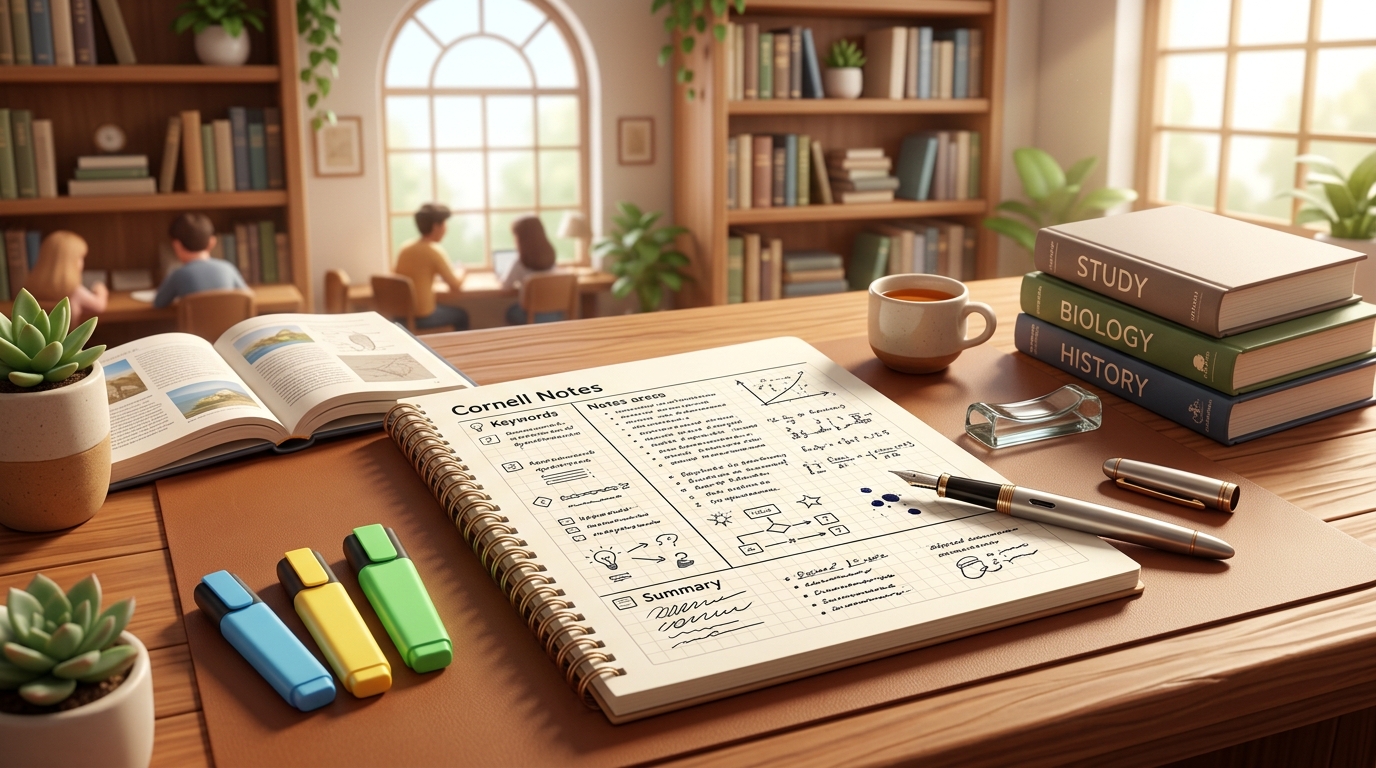
Hello everyone, I'm Teacher Taku. When mentoring students and adult professionals for competitive exams and professional certifications, I frequently hear common frustrations: "I spend hours taking neat, color-coded notes, but when the exam arrives, I completely freeze and cannot recall the facts," or "I tried the Cornell note-taking system because everyone praises it, but drawing dividing lines by hand felt so tedious that I quit after three days."
Observing thousands of students in high school classrooms reveals a decisive divide between those whose grades stall despite diligent note-taking and top-tier achievers. That difference does not stem from innate memory talent. It boils down to whether you treat your notebook merely as a passive storage vault or elevate it into an active self-testing engine that stimulates retrieval pathways during review.
Developed by Professor Walter Pauk at Cornell University, the Cornell Notes system has served as a gold standard learning framework across prestigious academic institutions and global enterprises for over half a century. However, mechanically copying teacher remarks into three split boxes yields less than ten percent of its true cognitive power. In alignment with modern self-directed digital learning guidelines from the U.S. Department of Education, this comprehensive guide synthesizes cutting-edge cognitive science—specifically Active Recall and Spaced Repetition—to present the definitive blueprint for Cornell Notes mastery!
- •The golden size ratios and cognitive roles of the 3 Cornell functional zones.
- •How to transition from mindless transcription to high-yield paraphrasing and cue questions.
- •Professor Pauk's foundational 5R framework and active recall recitation mechanics.
- •Step-by-step procedures to sync handwritten notes with digital flashcards and FSRS AI.
How to Set Up & Format Cornell Notes in 3 Sections
Functional Roles & Golden Size Ratios of the 3 Areas
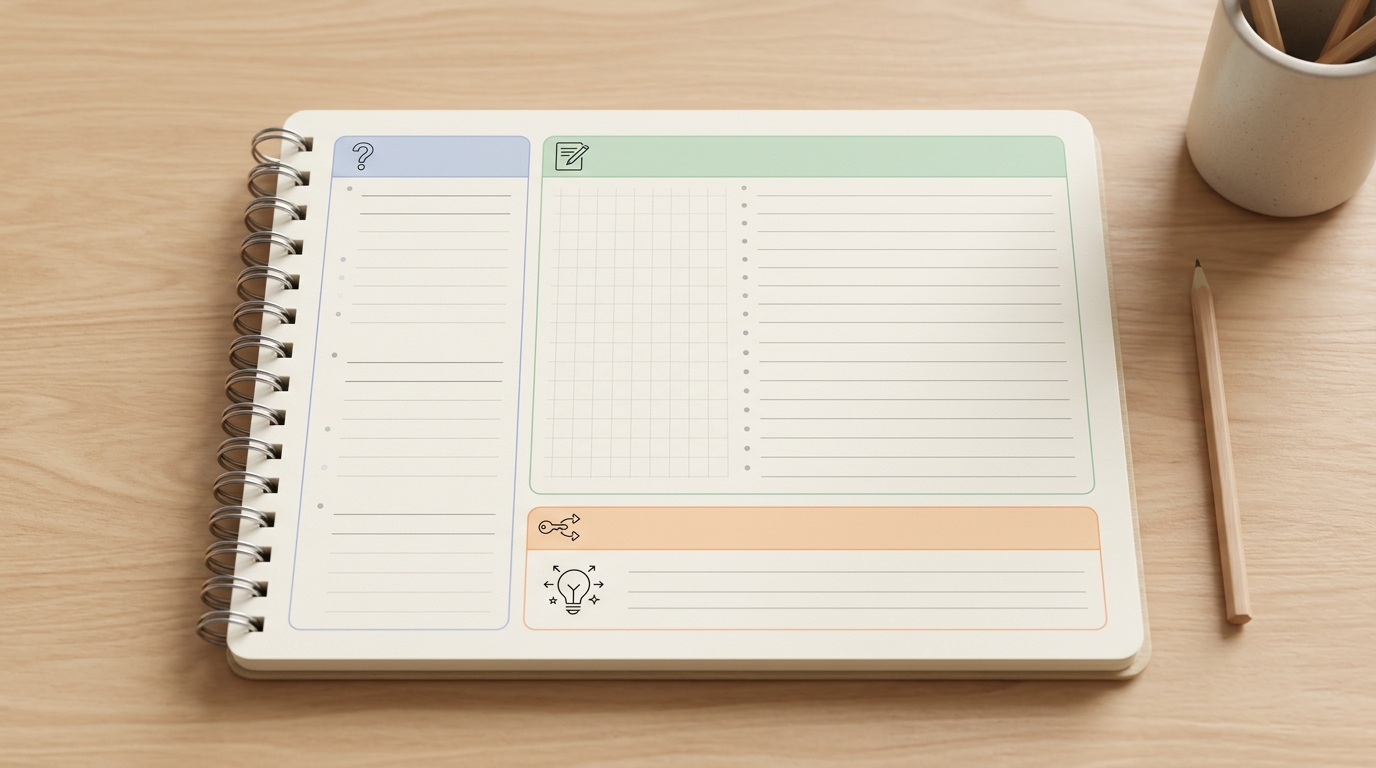
The defining hallmark of Cornell Notes lies in structuring every notebook page into three functional cognitive spaces. Many general study guides suggest drawing rough lines arbitrarily, but frontline classroom observation shows that distorted proportions frequently derail subsequent review routines. The most scientifically ergonomic and user-friendly golden ratio allocates approximately 70 percent of horizontal page width to the right-hand Notes area, roughly 30 percent to the left-hand Cue column, and a bottom Summary block spanning approximately 2 inches (5 to 6 cm, or roughly 20 percent of page height).
The right-hand Notes column functions as an agile workspace to record lecture points and textbook insights in real time. In contrast, the left-hand Cue column serves as a retrieval launchpad where you formulate questions and keywords to quiz yourself while concealing the notes area. Finally, the bottom Summary block acts as a high-density synthesis zone where you distill the core thesis of the page into one or two sentences in your own words. Clearly partitioning these three zones enables your brain to process recording, questioning, and synthesizing without cognitive interference.
Effective Note-Taking: Summarizing Lectures & Textbooks
When filling the right-hand notes area during classes or textbook readings, the most critical error to avoid is copying sentences word-for-word. Conscientious students often use multiple colorful gel pens to produce aesthetic transcriptions. However, seminal cognitive psychology research (Craik & Lockhart, 1972) establishes that mechanical copying constitutes shallow processing, failing to stimulate the neural pathways required for lasting memory consolidation.
The uncompromising rule for the notes column is to listen to the instructor, digest the concept mentally, and transcribe the takeaways in your own words using short bullet points, causal arrows, and standard abbreviations. For instance, render cause-and-effect statements as concise flows (A ➔ B), and leverage chunking memory techniques to compress complex data into manageable clusters of three to four units. Leaving generous margins ensures ample room for annotations and cue formulation later.
The Cue Column: Creating Questions That Accelerate Recall
Immediately after class or during your evening study block, you must execute the most pivotal step of the entire system: crafting the left-hand Cue column. Many novices simply copy isolated vocabulary words here, which strips away half the review potential. The true essence of the cue column is to generate targeted diagnostic questions designed to pull answers out of the adjacent notes column.
For example, if your notes column states: "Mitochondria: Double-membraned organelles generating adenosine triphosphate (ATP) via cellular respiration," write this cue question on the left: "Which double-membraned organelle synthesizes ATP?" When you later shield the notes column with a sheet of paper, your notebook instantly transforms into a self-grading exam sheet. Formulating questions to retrieve target facts triggers Active Recall, the gold standard for durable retention.
The Summary Section: Condensing Core Concepts in 1-2 Lines
Located at the foot of each page, the Summary section provides dedicated space to crystallize the fundamental thesis of the lesson. The primary pitfall observed in classroom coaching is re-writing notes line-by-line simply because blank paper remains. The summary block is not meant for lengthy rehashes. As a strict rule, condense the page's core message into one or two sentences (25 to 50 words) from the perspective of teaching the concept to a complete beginner.
This distillation process mirrors the Feynman Technique, where translating complex abstractions into accessible explanations exposes gaps in conceptual understanding. When forced to articulate the essence in your own words, the brain resolves ambiguities and reinforces hierarchical knowledge structures. During pre-exam crunch periods, flipping through these summary blocks allows you to reload entire chapter frameworks into working memory within minutes.
Overcoming the Two Major Drawbacks of Cornell Notes
While celebrated globally, Cornell Notes presents two common pain points: the manual friction of drawing layout grids across dozens of pages, and the difficulty of searching for specific past entries across physical paper stacks. Becoming bogged down by layout maintenance can discourage even motivated learners.
These obstacles vanish with pragmatic adjustments. Eliminate the manual setup friction by adopting pre-printed Cornell loose-leaf sheets, dedicated spiral notebooks, or simply sketching guidelines freehand without a ruler. To conquer search friction, record the date, subject code, and topic title prominently at the top header of every page, maintaining a lightweight table of contents in the front cover. Even better, transcribing your cue questions and summaries into digital tools like PathMemoria grants instant full-text search capability across thousands of study cards.
Science-Backed Review Protocols to Retain Knowledge with Cornell Notes
The Core of the 5R Framework Developed by Professor Pauk
In his seminal work 'How to Study in College', Professor Walter Pauk emphasized that the genius of Cornell Notes lies not in its grid lines, but in its cognitive execution framework known as the "5R System." Most learners halt their effort after step one, yet recording constitutes barely twenty percent of genuine learning.
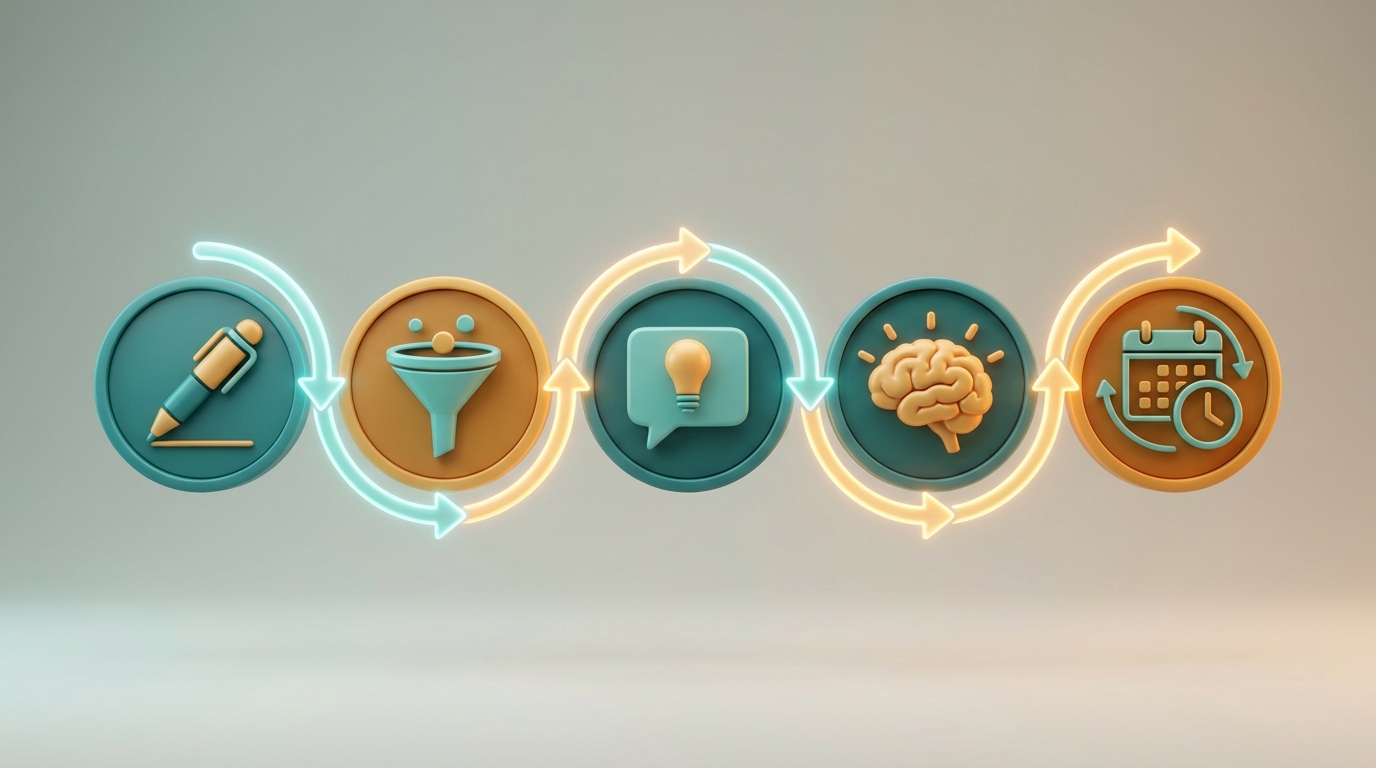
The 5R framework follows an elegant cyclical sequence: ① Record (log core points in the notes column) ➔ ② Reduce (distill points into cue questions) ➔ ③ Recite (cover notes and speak answers aloud) ➔ ④ Reflect (ponder connections to existing mental schemas) ➔ ⑤ Review (re-test at spaced intervals to beat forgetting). Translating notes into questions, retrieving answers unassisted, synthesizing connections, and re-evaluating over expanding time intervals transfers information from temporary hippocampal storage into permanent neocortical networks.
The Recite Test: Concealing Notes to Trigger Active Recall
Among the 5R stages, step three—Recite—exerts the most profound impact on retention velocity. High-performing students treat their notes not as reading material, but as testing material. Cover the right-hand notes area entirely with a blank sheet or folder, exposing only the left-hand cue column. Looking exclusively at each question, speak the answer aloud or reconstruct it deliberately in your thoughts.
In landmark cognitive research published in Science (Karpicke & Blunt, 2011), students who engaged in retrieval testing outperformed repetitive re-reading cohorts by roughly 1.5 to 2 times on delayed recall assessments. The neural strain experienced when wrestling to recall a forgotten fact is precisely what strengthens synaptic pathways. Place a small checkmark beside any item where recall stalled, peek at the notes column for immediate feedback, and proceed.

Science-Backed Review Intervals to Beat the Forgetting Curve
Even the most immaculate notes decay rapidly if review timing is mismanaged. The human brain sheds the majority of newly encoded information within days unless prompted by strategic rehearsals. Harnessing Professor Pauk's Review phase requires synchronizing your schedule with Forgetting Curve optimal timings and Spaced Repetition principles.
| Review Stage | Recommended Window | Cornell Notes Action | Duration |
|---|---|---|---|
| 1st Review | Same evening (Within 24h) | Complete cue questions and summary; perform first full recitation test | 5-10 min |
| 2nd Review | 3 days post-creation | Cover notes and rapid-fire quiz cue questions; flag hesitations | 3-5 min |
| 3rd Review | 1 week post-creation | Target flagged weak items and rehearse high-level summary concepts | 3 min |
| 4th Review | 2 to 4 weeks post-creation | Combine with Blurting Method on blank sheets for a final diagnostic sweep | 5 min |
Re-testing knowledge right as it begins to slip away cements neural engrams while slashing review duration down to mere minutes per session. Simply logging future rehearsal dates in a planner keeps your memory trajectory perfectly on schedule.
Seamless Synergy with Digital Flashcards & FSRS AI
Once you have structured insights into questions and answers on paper, importing those data pairs into digital study tools propels learning productivity into unprecedented territory. The greatest friction of physical notebooks is manually deciding which page warrants review on any given day. Modern memory applications featured in flashcard app comparisons eradicate this overhead completely.
The workflow is remarkably straightforward: configure your left-hand cue question as the front prompt of a digital card, assigning your notes points and summary explanation to the back face. You can compile your lists in spreadsheets and bulk-upload them using our Excel and CSV Import Guide. When loaded into an AI flashcard engine like PathMemoria, the state-of-the-art Free Spaced Repetition Scheduler (FSRS) dynamically calculates card stability and target retention, serving cards right as memories start to fade. Reviewing cue cards hands-free on smartphones during morning commutes makes consistent active recall completely effortless.

Summary: Transform Cornell Notes into Permanent Long-Term Memory
The authentic objective of note-taking is never to curate an aesthetic museum piece. It is to build a personalized diagnostic testing battery that enables your future self to retrieve vital facts effortlessly under intense exam conditions. The Cornell Notes method encapsulates every principle of active learning: synthesizing thought in the notes area, forging sharp inquiry prompts in the cue column, and distilling foundational truths in the summary block.
Begin with a single page during your very next class or reading session. Draw your vertical line 2.5 inches from the left margin, add a bottom boundary, and experience the invigorating clarity of the Cornell format. Cover your notes, test yourself directly from the cue questions, and feel the neural spark of genuine retrieval. Translating those questions into an algorithmic platform like PathMemoria liberates you permanently from forgetting anxiety. Step away from passive, mechanical transcription today, and unlock the boundless potential of science-backed note-taking!
📝 [Check Quiz 1] Reinforcing the Role of the Cue Column
[Question] What represents the most effective type of content to record in the left-hand Cue column?
💡 View Answer & Explanation
[Answer] Formulating targeted diagnostic questions and retrieval prompts designed to pull answers out of the notes column.
[Explanation] Rather than copying passive keywords, crafting explicit questions instantly transforms the entire page into a self-testing active recall exam whenever the notes area is concealed.
📝 [Check Quiz 2] Mastering the 5R Framework
[Question] List the five sequential steps of Professor Walter Pauk's 5R system in proper chronological order.
💡 View Answer & Explanation
[Answer] ① Record ➔ ② Reduce ➔ ③ Recite ➔ ④ Reflect ➔ ⑤ Review.
[Explanation] Moving beyond mere recording to reduce points into questions, recite answers aloud, reflect on conceptual schemas, and review at spaced intervals provides the complete neurological cycle for lifelong retention.


![[2026 Guide] The Blurting Method: Skyrocket Memory Retention with Active Recall & AI](https://pathmemoria.tsmichi.com/blog/blurting_hero.jpg)