
Hello everyone, I'm Teacher Taku. When preparing for critical academic exams, standardized tests, or professional certifications, have you ever felt the common frustration: "I can answer fluently while hiding words with a red plastic sheet at my desk, but the moment I face a completely blank exam paper, my mind goes totally blank"? Or: "I keep re-covering words I already know alongside words I struggle with, wasting hours without making real progress"?
Over my two decades coaching thousands of high school students and developing memory algorithms, I routinely see dedicated learners spreading red sheets and green highlighter markers across thick reference books, reciting terms under their breath. For generations, the red sheet study method has been heralded as the undisputed king of exam memorization.
However, when evaluated through rigorous cognitive psychology and educational neuroscience, traditional red sheet study conceals critical cognitive pitfalls that severely impair long-term memory formation. Learners who study diligently yet see their scores stall on exam day are frequently trapped by the false sense of mastery that translucent sheets create.
In alignment with self-directed digital learning guidelines from the U.S. Department of Education promoting evidence-based learning, this comprehensive guide unpacks the cognitive vulnerabilities of red sheet study and reveals the definitive next-generation alternative: combining unassisted Active Recall with the adaptive FSRS forgetting curve AI for permanent retention!
- •The 3 cognitive pitfalls explaining why red sheet study fails on real exams.
- •How context cues and page layouts trigger the deceptive Fluency Illusion.
- •The massive time waste caused by the inability to filter mastered from unmastered items.
- •How to pair Active Recall with FSRS AI and Image Occlusion for effortless long-term memory.
| Evaluation Dimension | Traditional Red Sheet Study | Next-Gen Retrieval Protocol (Active Recall x FSRS) |
|---|---|---|
| Cognitive Retrieval Mode | Context-dependent guessing from surrounding text | Pure active retrieval from internal memory storage |
| Metacognitive Accuracy | High Fluency Illusion (mistaking familiarity for mastery) | Objective diagnostic feedback on exact memory gaps |
| Review Workload Efficiency | Extremely low (mastered items are repeatedly covered) | Maximum efficiency (AI serves only fading weak points) |
| Study Ergonomics & Location | Desk-bound (two hands required to hold books and slide sheets) | Completely agile (one-thumb mobile taps or hands-free audio) |
| Exam Performance Transfer | Fragile (easily collapses under randomized test formats) | Robust (reflexive recall across any question format) |
Why Red Sheet Study Fails: 3 Cognitive Pitfalls Exposed by Science
Walk into any bookstore or stationery shop, and red sheets alongside erasable green highlighters dominate the aisles. Why has this decades-old staple turned into a stumbling block for modern test-takers? Let us examine the structural flaws through cognitive psychology and classroom data.
The Real Reason Red Sheets are Outdated in Modern Exams
Conventional wisdom claims that repeatedly masking words with a red sheet guarantees effortless retention for anyone. However, tracking student performance across hundreds of mock exams reveals a stark disparity: students heavily reliant on red sheets often score acceptably on routine quizzes with predictable formats, yet suffer dramatic score collapses on comprehensive entrance exams and past papers.
The fundamental reason red sheet study is increasingly obsolete is that it degenerates into a "passive recognition drill" that exerts almost zero retrieval strain on the brain. For knowledge to transfer into long-term neocortical networks, the brain must engage in deliberate retrieval search—wrestling with "What was that specific concept?"—which physically thickens synaptic connections.
Sliding a translucent plastic sheet down a page allows answers to bleed through or be exposed with the slightest hand movement, shielding the brain from genuine retrieval effort. This comfortable ease is the exact reason knowledge fails to materialize under exam hall pressure.
The Fluency Illusion: Deceptive Context Clues from Open Books
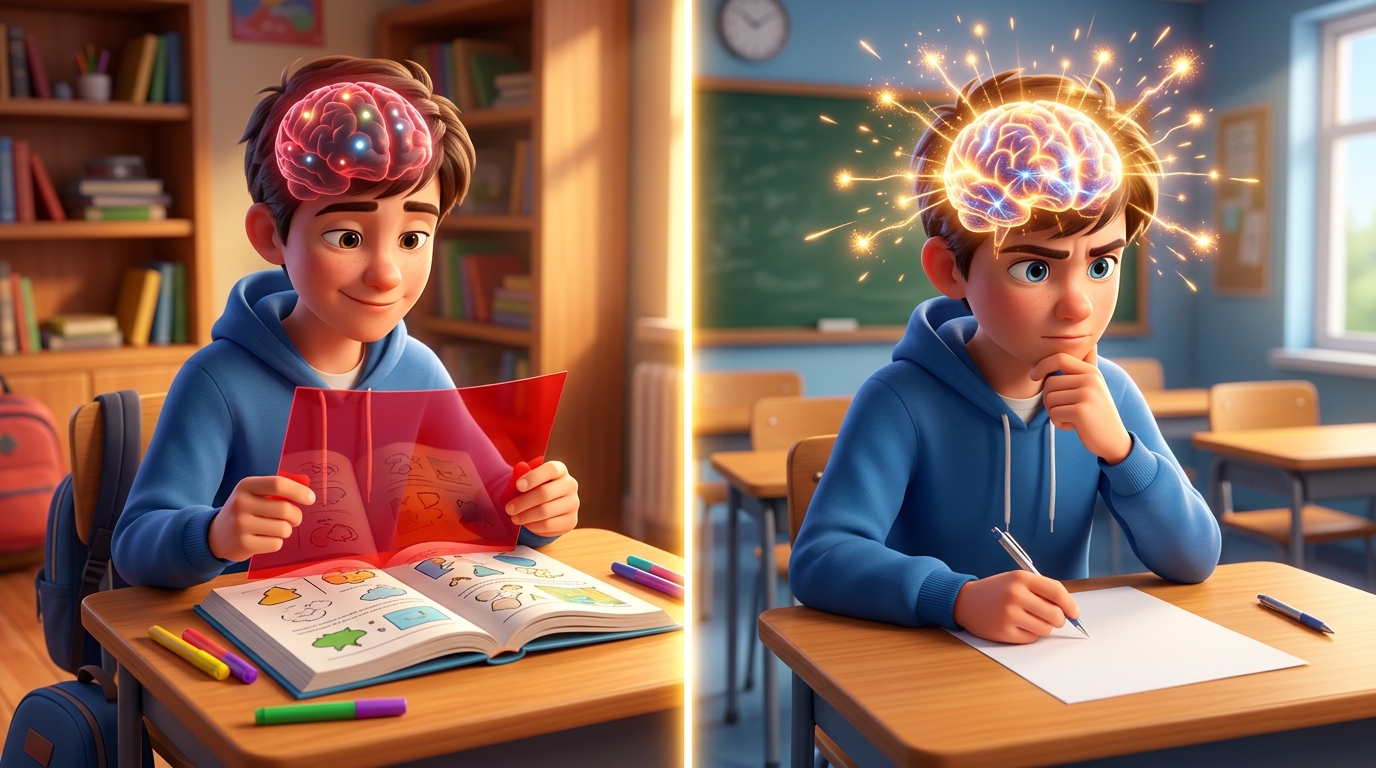
The most deceptive trap of red sheet study is what cognitive scientists designate as the "Fluency Illusion". When masking a word within a textbook sentence, the surrounding grammatical structure, neighboring diagrams, and physical layout on the page (such as "it's at the top left of the page") leak massive contextual cues into working memory.
The brain does not retrieve the concept in isolation; it merely completes the syntactic sentence flow. The student nods, fully convinced they have locked the concept into permanent memory.
On actual exam papers, however, textbook paragraphs never appear word-for-word. Facing isolated questions on a blank answer sheet, all external scaffolding vanishes. Without surrounding context cues, working memory stalls, and the student freezes in panic.
The Time-Waster Trap: Mindlessly Hiding Mastered Vocabulary

The second structural bottleneck of physical red sheets is their inability to isolate mastered facts from unlearned items. Covering an entire printed page forces you to conceal every highlighted word indiscriminately, regardless of mastery.
If you have already consolidated 80 out of 100 terms, reviewing the remaining 20 weak points still requires sliding your plastic sheet across all 100 terms. This squanders eighty percent of your precious study time re-verifying facts you already know.
To maximize exam ROI, learning science dictates focusing exclusively on knowledge boundaries. Because red sheets cannot filter individual card states, they morph into massive time-wasters that create high fatigue with negligible score improvement.
Physical Strain: Eye Fatigue and Immobilized Hands on Transits
Beyond cognitive deficits, physical and ergonomic limitations severely restrict red sheet practicality. Staring continuously through red or green transparent plastic strains retinal cone photoreceptors, frequently triggering eye fatigue, blurred vision, and tension headaches during long study blocks.
Furthermore, red sheet study requires continuous two-handed manipulation. Your left hand must firmly hold bulky reference books open, while your right hand must slide the sheet line by line. This physical requirement completely eliminates the ability to study on crowded trains or during standing commutes.
For modern working professionals and active students, transition times during daily transit represent the largest untapped study window. Relying on an apparatus that demands a flat desk and two free hands is fundamentally incompatible with agile modern schedules.
Direct Answer: Is Covering Textbooks with Red Sheets Effective?
In short, covering textbooks with red sheets offers minimal utility for initial familiarity, but is fundamentally inadequate for durable long-term retention. Relying on surrounding context cues severely prevents unassisted recall under test conditions.
Beyond the Red Sheet: Next-Gen Active Recall & FSRS Protocols
How can you eliminate red sheet inefficiencies while locking vital facts into long-term memory in half the time? Cognitive psychology and modern educational technology point to an integrated protocol deployed by elite learners worldwide.
Science-Backed Active Recall as the Ultimate Red Sheet Replacement

The gold-standard scientific replacement for red sheets is Active Recall (Retrieval Practice). Instead of filling in masked blanks within familiar text, you prompt your memory using an isolated question, pulling the solution unassisted from memory storage.
In a landmark paper published in Science (Karpicke & Roediger, 2008), researchers demonstrated that students who repeatedly engaged in retrieval testing achieved more than double the long-term retention of cohorts who repeatedly re-read materials.
Decoupling questions from answers strips away deceptive context scaffolding. The cognitive exertion of searching unassisted memory triggers Long-Term Potentiation (LTP), forging resilient synaptic engrams that execute effortlessly on exam day.
Automated Mastery Sorting via FSRS Forgetting Curve AI
To eliminate the sorting dilemma that cripples physical flashcards and red sheets, modern platforms leverage the FSRS (Free Spaced Repetition Scheduler) algorithm.
FSRS models card difficulty and memory stability dynamically based on your response ratings (Again, Hard, Good, Perfect). When you master a card, the algorithm pushes the next review interval out to 4 days, 12 days, and 35 days, while instantly queueing missed items for tomorrow's session.
This automated triage eradicates redundant reviews entirely. Your study time is concentrated exclusively on items approaching the biological forgetting threshold, reducing daily review counts by over thirty percent while sustaining ninety percent retention.
Hands-Free Visual Masking: The Mobile Image Occlusion Revolution

For diagrams, maps, anatomical plates, and mathematical proofs where visual layout is essential, physical sheets have historically been the default choice. Today, digital Image Occlusion Masking delivers a far superior alternative.
Snap a photo of any textbook page or handout with your smartphone, and trace rectangles over key labels. Modern apps instantly generate interactive digital masks. Tapping any mask reveals the answer, allowing you to log ratings in a fraction of a second.
Reference books remain completely pristine, and hundreds of complex diagrams fit seamlessly into your pocket. Compared to bulky physical highlighters, digital occlusion offers unparalleled speed and organization.
Commute Gap-Time Mastery: Audio Retrieval Drills on the Go
For busy candidates struggling to secure desk hours, automated Voice Autoplay transforms transit into an active retrieval gym.
Using PathMemoria's background voice playback, your phone vocalizes question prompts into your wireless earbuds. A configurable 3-second silent pause follows, giving your brain space to perform mental active recall before the correct answer is spoken.
Whether navigating packed subway cars, walking to campus, or resting tired eyes before sleep, high-intensity memory consolidation continues completely hands-free. Converting small transition pockets into study hours empowers you to outpace competitors without sacrificing personal life.
Summary: Upgrade Your Red Sheet Routine into Next-Gen Memory Mastery
While the red sheet method provided generations of students with an initial step toward testing, its vulnerability to context clues, lack of automated sorting, and physical limitations restrict performance on modern exams. Achieving top-tier scores requires trading manual friction for cognitive science.
Embrace unassisted Active Recall, automate your review schedule with the FSRS algorithm, and exploit mobile Image Occlusion and audio gap-time drills. For a detailed breakdown of tools, consult our comprehensive Best Flashcard Apps Comparison.
Engineered by classroom teachers, PathMemoria integrates these cognitive tools into a free web application. Take ten seconds to test your flashcards today, and experience the transformative clarity of science-backed memorization!
📝 [Check Quiz 1] The Fluency Illusion in Red Sheet Study
[Question] What cognitive bias occurs when learners mistake context clues surrounding a masked word for genuine memory mastery?
💡 View Answer & Explanation
[Answer] The Fluency Illusion.
[Explanation] Seeing neighboring grammatical structure and layout cues allows the brain to complete sentences without unassisted memory search, generating a false impression of mastery that fails on blank exam sheets.
📝 [Check Quiz 2] Algorithmic Resolution to the Sorting Dilemma
[Question] What memory algorithm resolves the sorting dilemma by expanding review intervals for mastered facts while automatically serving fading items?
💡 View Answer & Explanation
[Answer] FSRS (Free Spaced Repetition Scheduler).
[Explanation] By calculating individual memory stability and targeting reviews right before decay, FSRS cuts redundant review volume by over 30% while securing durable 90%+ retention.


![[2026 Guide] The Blurting Method: Skyrocket Memory Retention with Active Recall & AI](https://pathmemoria.tsmichi.com/blog/blurting_hero.jpg)