![High School Computer Science & Algorithm Memorization: How to Master Python, Logic Gates, and Pseudocode with Spaced Repetition [2026 Edition]](https://pathmemoria.tsmichi.com/blog/blog_common_test_info1_hero.jpg)
"I want to master high school Computer Science (AP CS, IB CS, or college entrance exam algorithms), but the textbooks are packed with so many technical terms, networking protocols, and legal rules that I don't know what to memorize..."
"Because I come from a non-programming background, nested loops, conditional branches, and variable mutation feel overwhelming, and I constantly run out of time during algorithm tracing sections..."
Standardized computer science examinations demand both conceptual legal/networking memory and lightning-fast algorithmic tracing. Many high schoolers and college applicants hit a severe wall, wondering how much precious study time to allocate without sabotaging their core math, language, and science preparation.
Let me introduce myself. For over 20 years, I have served as a licensed high school educator, homeroom mentor, and academic counselor guiding hundreds of students through competitive university entrance exams, standardized certifications, and specialized examinations. While my formal academic background is in the humanities and language education, I personally taught myself programming from scratch—mastering VBA and Python—and engineered an entire modern web application (PathMemoria) from the ground up.
From observing students across all disciplines in the guidance office, one harsh truth is abundantly clear: those who crash in computer science examinations misunderstand the fundamental nature of algorithmic study. Struggling students either attempt to brute-force memorize hundreds of textbook definitions, or they try to mentally calculate multi-variable loops in their heads, inevitably making catastrophic calculation errors. Conversely, candidates who achieve scores in the 90th percentile with merely 30 to 40 hours of preparation strictly minimize rote memorization and solve algorithms using structured active recall protocols.
In this comprehensive guide, combining 20 years of academic coaching with real-world software development insights and modern cognitive psychology, I present the ultimate protocol to conquer high school computer science and algorithms with maximum efficiency!
- •Drawing a strict line between pure memory terms and real-time algorithmic reasoning
- •Mastering network protocols and public-key cryptography via FSRS spaced repetition
- •Internalizing logic gate truth tables and binary conversions with Image Occlusion
- •The zero-fatigue hand-drawn trace matrix protocol to eliminate loop errors completely
In high-stakes academic testing, students are often consumed by heavy calculus, physics, and literature loads, frequently postponing computer science until the final weeks. However, high school computer science syllabi strictly reflect foundational principles—requiring zero mathematical flash of genius. Once you master core syntax patterns and essential protocols, computer science becomes the single highest-ROI discipline where a score above 85-90% can be locked in with minimal hours. Do not fear it. Clear it with a disciplined backward-calculated schedule.
Mastering High School CS: Separating Core Rote Terms from Algorithmic Logic
The first strategic step toward a top-tier computer science score is decisively separating "facts that must be memorized" from "problems to be solved logically in real time." Official curriculum frameworks published by academic authorities demonstrate that pure rote questions comprise barely 30% of standard examinations. The remaining 70% tests systematic reasoning. For overarching guidance on building scientific study timelines, see our pillar guide on Scientific Study Planning and Schedule Design.
The High School Trap: Procrastination and Last-Minute Cramming Disasters
In academic counseling, the single most frequent regret voiced by candidates is leaving computer science completely untouched until late in the semester, only to be overwhelmed by the staggering volume of diagrams, pseudocode specifications, and technical standards.
Misguided forum advice often claims that computer science can be crammed in a single weekend. However, modern standardized tests feature extensive multi-page scenario prompts, system architecture schemas, and tight 60-minute time limits. Cramming raw definitions at the last minute leaves learners paralyzed by cognitive overload during actual multi-variable code execution.
Conversely, science-oriented students often fall into the opposite trap: overconfidently assuming their programming familiarity exempts them from study, only to lose decisive marks on theoretical topics such as public-key infrastructure, digital signatures, phishing vectors, DNS hierarchical resolution, and OSI packet routing. Consistently securing high percentiles requires daily 10-minute active retrieval sessions rather than reckless eleventh-hour cramming.
What to Memorize vs What to Solve: Drawing the Critical Line
To be unequivocal: the only items that require hard memorization are foundational legal frameworks, data security standards, and fundamental networking protocols.
Specifically, these include intellectual property laws (fair use, citation standards, licensing models), privacy protection regulations, symmetric vs asymmetric encryption key distribution, IP addressing schemas (IPv4 32-bit vs IPv6 128-bit structure), DNS domain tree hierarchies, and packet-switching mechanisms. Because standardized examination questions do not define these baseline concepts inside the prompt, failing to recall them immediately results in lost points.
In sharp contrast, scatterplot correlation analysis, logic circuit gate outputs, and algorithm variable state transitions are procedural problem-solving tasks. Attempting to memorize thick reference books cover-to-cover is futile; extract atomic knowledge flashcards for core terms, and dedicate all remaining cognitive bandwidth to algorithm execution drills. For card optimization principles, see How to Create Effective Flashcards.
Rapid-Fire Networking & Cryptography Mastery via FSRS Spaced Repetition
In computer science, memorizing terminology in isolation is useless; you must connect each mechanism's primary purpose with its exact operational sequence so you can identify the correct protocol within 0.5 seconds.
In landmark cognitive research published in Science (Karpicke & Roediger, 2008), scientists demonstrated that passive textbook re-reading creates an illusion of competence that evaporates under test conditions. In contrast, actively retrieving knowledge through spaced testing produces robust, decay-resistant neural representations.
This is where the cutting-edge Free Spaced Repetition Scheduler (FSRS) algorithm in PathMemoria delivers a decisive advantage. By tracking your personal memory stability and item difficulty, FSRS isolates challenging concepts—such as DNS cache poisoning vulnerabilities or asymmetric key pairs—and schedules them right before forgetting occurs. Ten minutes of automated daily retrieval during daily transit solidifies recall without consuming precious desk time. Learn the cognitive foundations in Forgetting Curve and Optimal Review Timing.
Visual Pattern Mastery of Logic Gates & Binary Conversions with Image Occlusion

Foundational computing theory often challenges non-STEM students with two concepts: binary-hexadecimal base conversion and logic gate truth tables (AND, OR, NOT, XOR).
Tracing logic circuits step-by-step in prose ("When Input A is 0 and Input B is 1 through a NOT gate...") consumes two to three minutes per question. Elite test-takers do not read gates as text; they recognize gate silhouettes—D-shape for AND, curved crescent for OR, triangle-circle for NOT, double crescent for XOR—as instantaneous visual patterns.
The most powerful tool for mastering this spatial reasoning is the Image Occlusion feature in PathMemoria. By capturing an image of circuit diagrams or truth tables and masking critical output nodes, you convert textbook schematics into interactive visual quizzes in seconds. Practicing with intact spatial relationships enables instant reflex recall during complex multi-stage circuits. Explore this technique in How to Use Image Occlusion Flashcard Apps.
A 30-to-40-Hour Back-Calculation Study Schedule for Exam Readiness
From an academic counseling perspective, the target investment for computer science readiness across competitive admissions is 30 to 40 total study hours.
Spending 80 or 100 hours compromises preparation in heavily weighted core subjects like calculus or advanced languages. Here is our proven three-phase back-calculated schedule model:
• Phase 1 (Months 4-3 Before Exam / 10 Hours Total): Complete one conceptual overview of foundational units (digital data, logic networks, algorithms, societal impact). Convert every ambiguous technical term directly into digital flashcards.
• Phase 2 (Months 2-1 Before Exam / 15 Hours Total): Complete topical past-paper problem sets. Focus intensely on developing the hand-drawn variable trace matrix for algorithm questions.
• Phase 3 (Final 4 Weeks / 10-15 Hours Total): Complete full-length timed mock exams under a strict 60-minute countdown once weekly. Target identified weak points through mobile FSRS retrieval sessions.
Executing this roadmap requires merely 15 to 20 focused minutes daily, leaving your core academic schedule completely unburdened.
Conquering Pseudocode & Algorithms through Active Recall Training
The core battlefield of standardized computer science testing is the algorithm section, typically commanding 30% of total exam weight. Many students experience deep anxiety here, yet standardized pseudocode follows predictable rules. Here is our dual educator-developer protocol for mastering code execution.
The Biggest Hurdle in Pseudocode: Equivalence vs Variable Assignment
Standardized computer science exams utilize language-agnostic pseudocode rather than specific commercial languages like Python or Java.
From my experience learning programming independently, the single biggest cognitive stumbling block for beginners is confusing mathematical equality (=) with algorithmic assignment (=). When seeing an expression like "x = x + 1", a mathematical mind reflexively recoils, thinking x can never equal x plus one. In programming, "=" merely instructs the processor to evaluate the right-hand expression and overwrite the storage container on the left with that new value.
A second common trap is overlooking zero-based versus one-based array indexing definitions. Failing to confirm whether arrays begin at index 0 or index 1, or confusing loop termination boundaries ("<" vs "<="), can invalidate an entire multi-part question. Cease trying to interpret code by intuition; adopt the mindset of an unemotional compiler following explicit mechanical rules.
Zero Working-Memory Fatigue: The Hand-Drawn Variable Trace Matrix
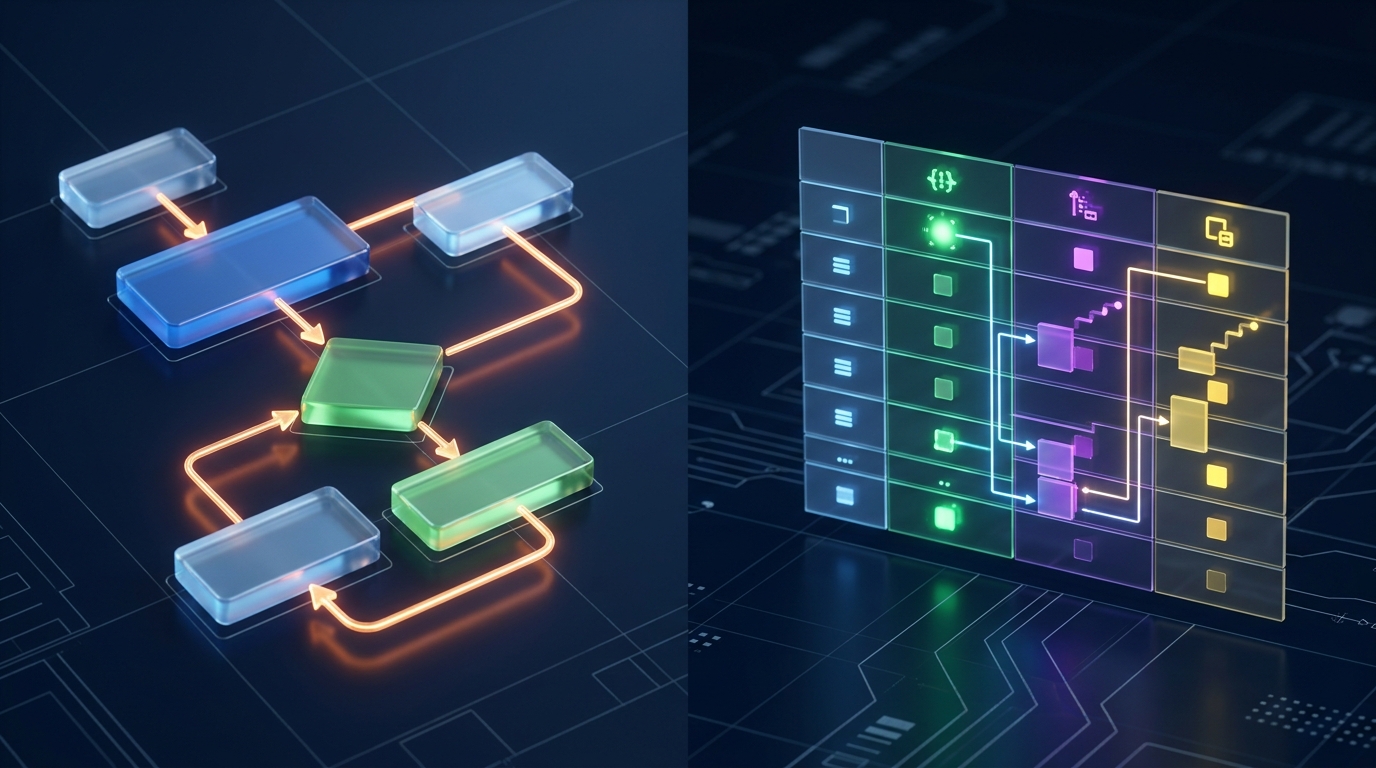
Nearly every student who loses marks on algorithm questions makes the same fatal mistake: attempting to track shifting variable values entirely in their heads.
Cognitive research shows that human working memory can juggle merely three to four chunks of information simultaneously. When loop variable "i" increments, array element "data[i]" updates, accumulator "total" recalculates, and Boolean "flag" flips, mental calculation inevitably fails under timed test stress.
The decisive solution is constructing a hand-drawn trace matrix in the exam margin. Draw iteration numbers (Round 1, 2, 3...) vertically, place variable labels (i, total, current_max) horizontally, and write down updated values line by line. Offloading cognitive state tracking onto scratch paper reduces working-memory errors to zero. During practice, never passively observe answer keys; reconstruct blank trace matrices from scratch. See the cognitive science in The Active Recall Method.
Mastering Binary Search & Sorting Algorithms with Active Recall
Core algorithmic paradigms—linear search, binary search, bubble sort, and selection sort—appear consistently in standardized tests under varying problem narratives.
Unprepared candidates attempt to comprehend these algorithms from first principles inside the exam hall, running out of time. High scorers carry the structural skeletal patterns (initialization, midpoint calculation mid = (low + high) // 2, pointer shifting, and swap logic) firmly in long-term memory, instantly recognizing expected loop operations upon skimming the code.
The fastest way to internalize algorithm structures is self-explanation through active recall: explain the step-by-step logic aloud without looking at reference material. Can you clearly articulate why binary search requires a sorted array, or why the outer loop of a bubble sort executes N-1 times? When you can articulate the procedural flow in plain language, tracing examination code becomes effortless.
Diagnosing Practice Test Mistakes: A 3-Tier Error Analysis Protocol
After completing mock assessments, never stop at checking your raw percentage score.
In academic coaching, we enforce a strict three-tier error classification protocol for every missed question:
1. Knowledge Void (Recall Deficit): Missing a technical standard or protocol definition ➔ Immediately record the item into PathMemoria for FSRS scheduling.
2. Working-Memory Collapse (Execution Deficit): Attempting mental calculations instead of maintaining a clean trace matrix ➔ Re-solve the question on blank paper with an explicit step-by-step variable table.
3. Misread Preconditions (Attention Deficit): Skimming over constraints such as "assume distinct array elements" ➔ Enforce the physical habit of underlining all conditional premises with a pen.
Categorizing mistakes objectively prevents recurring errors and solidifies problem-solving routines. For managing large volumes of past test errors on a PC, utilize our spreadsheet workflow in Excel & CSV Bulk Import Guide.
Exam Pacing Strategy: How to Score in the 90th Percentile under Strict Time Limits

The final determinant of scoring in the 90th percentile is disciplined 60-minute time allocation.
Standard four-section examination models demand the heaviest analytical reasoning in Sections 3 (Algorithms) and 4 (Data Modeling). Lingering excessively on early theoretical questions creates fatal time deficits later. We recommend this standard pacing framework:
• Section 1 (Core Concepts & Digital Society): 10 minutes (Target: 18+/20)
• Section 2 (Networking, Protocols & Design): 15 minutes (Target: 22+/25)
• Section 3 (Algorithms & Pseudocode Execution): 20 minutes (Target: 25+/30)
• Section 4 (Data Modeling & Statistical Analysis): 12 minutes (Target: 22+/25)
• Final Verification & Answer Sheet Audit: 3 minutes
Pacing through Sections 1, 2, and 4 before executing Section 3 secures reliable baseline points first, providing psychological composure to tackle algorithm tracing methodically without rushing.
Summary: Dominate Computer Science & Algorithms with Cognitive Science
Standardized computer science tests represent an unfamiliar challenge to many test-takers. Yet for students armed with a disciplined, science-backed approach, it is the single easiest subject to establish a commanding competitive advantage.
You do not need to memorize encyclopedic textbooks. Automate recall of network protocols and logic gates with Image Occlusion and FSRS spaced repetition, and eliminate algorithmic execution errors using structured trace matrices. This evidence-based strategy secures top-percentile outcomes while keeping your core study schedule intact.
Take action today: extract three missed concepts from your recent practice set and input them into PathMemoria. A few moments of smart daily retrieval will become the cornerstone of your academic breakthrough!


![[2026 Guide] The Blurting Method: Skyrocket Memory Retention with Active Recall & AI](https://pathmemoria.tsmichi.com/blog/blurting_hero.jpg)